
Phone Charging Station Hire at Allianz Stadium Twickenham
Hire and Rental Phone charging lockers at Allianz Stadium, Twickenham
Hire and Rental Phone charging tables at Allianz Stadium, Twickenham
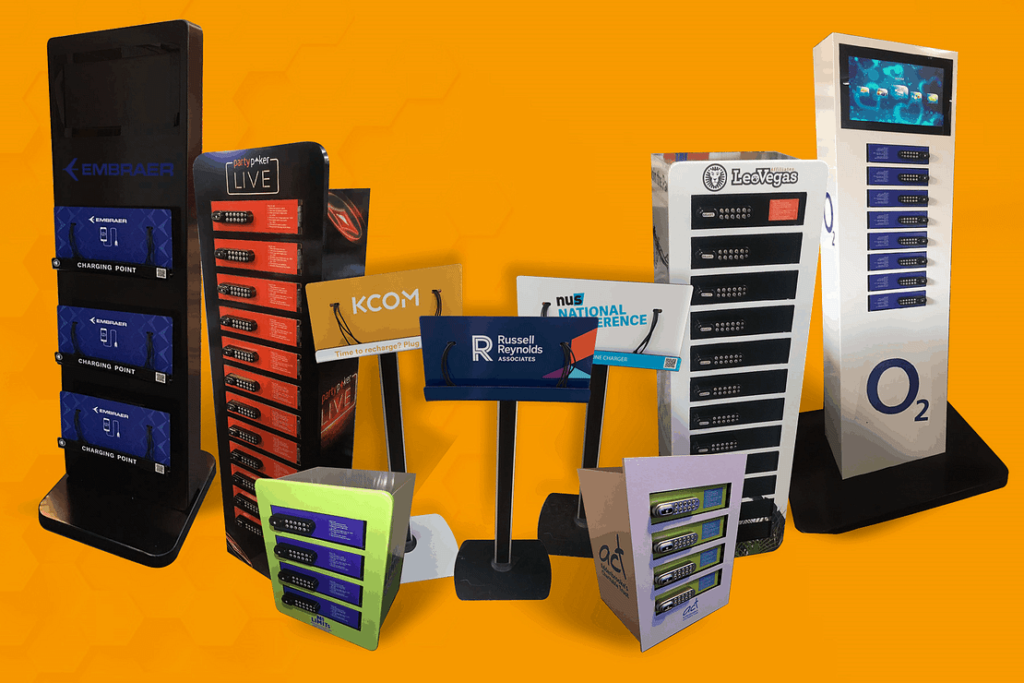
Chargezone Phone Charging stations
A successful event depends on hundreds of practical details, many of which visitors never consciously notice. Phone charging is one of them. When it is absent, a fading battery can become an unwelcome distraction. When it is planned properly, charging becomes a useful guest service, a natural meeting point and a credible platform for event or sponsor branding.
For organisers working at Allianz Stadium in Twickenham, the opportunity is particularly relevant. The venue can support exhibitions, conferences, hospitality programmes, corporate events and outdoor experiences. Each format creates different patterns of movement and different reasons for guests to rely on their phones. Delegates may need access to event apps, digital tickets, email, messaging, travel information, contact details or content shared during the day. Exhibitors and production teams have their own operational demands. A practical charging provision helps people stay connected without forcing them to leave the event in search of a socket.
ChargeZone supplies phone charging lockers and standard non-locker phone charging stations for events across the UK, with options for short-term hire and longer-term rental. Equipment can be used as a straightforward visitor amenity or developed into a branded activation for an event, exhibitor or sponsor. Support can cover exhibitions, conferences, corporate occasions, hospitality, festivals and other live environments.
This guide explains how to approach event phone charging station hire at Allianz Stadium, including the difference between lockers and open charging stations, where to place equipment, how to estimate quantity, and how to use branding without compromising the service. It also explains a particularly useful ChargeZone offer for organisers preparing an order now:
Order today and receive free branding featuring your sponsor’s logo, a free additional phone charging locker, a free additional standard non-locker phone charging station, and free flexible delivery.
That combination adds practical capacity as well as promotional value. The extra locker supports visitors who prefer to leave a device in a compartment while it charges, subject to the operating arrangements chosen for the event. The extra standard station supports more visible, open-access charging. Sponsor branding turns a necessary service into a relevant piece of event media. Flexible delivery helps the equipment plan fit around the wider event schedule rather than being treated as an isolated drop-off.
Whether you are an exhibition organiser, conference producer, venue manager, corporate event planner, agency, production company, marketing manager or individual exhibitor, the aim is the same: choose a charging solution that works in the real event environment. The best plan considers the audience, programme, dwell time, floorplan, staffing, brand objectives and delivery arrangements together.
Allianz Stadium: a major Twickenham setting for business and live events
Twickenham Stadium is now officially Allianz Stadium. Alongside its sporting identity, the venue offers more than 7,000 m² of exhibition and conference space. The 1,180 m² Rose Suite and 440 m² Live Room provide contrasting environments for organisers, while outdoor space can accommodate large exhibitions and festival-style events.
Those details matter because phone charging is not a one-format product. A compact conference with a tightly managed agenda needs a different layout from a broad exhibition where people circulate between stands. A hospitality event may place greater emphasis on discreet service and visual finish. An outdoor programme may need a delivery, placement and supervision plan that reflects changing conditions and the specific event infrastructure.
Charging in a large, multi-space venue
In a venue with multiple event areas, demand rarely appears evenly. The busiest charging point might be near registration in the morning, close to refreshment areas at lunch, and outside a plenary room before the final session. At an exhibition, the strongest demand may occur where visitors pause rather than where footfall is simply highest. At a corporate evening, it may build around the transition from formal content to drinks, dining or entertainment.
A useful plan therefore starts with the attendee journey. Map where people arrive, queue, sit, network, eat and wait. Then ask where charging would feel convenient without interrupting movement. This produces a more thoughtful result than placing all equipment in one area because it happens to have spare floor space.
The scale of Allianz Stadium also makes wayfinding important. A charging unit that cannot be seen or found may be underused even when demand exists. Directional signs, event-app listings, announcements or simple floorplan markers can help. If the charging point is sponsor-branded, those signposts also extend the activation beyond the immediate footprint.
Matching the solution to the room and programme
The Rose Suite’s substantial floor area can support ambitious layouts, but scale should not lead to a single centralised charging point by default. Several well-chosen locations may serve visitors better than one bank of equipment at an edge of the room. The Live Room may call for a more concentrated arrangement, with charging placed around genuine dwell zones rather than in circulation routes. For outdoor or festival-style use, organisers should review the proposed installation with the relevant venue, production and health-and-safety teams before confirming the position.
The room name alone does not decide the charging specification. A seated conference, banquet, product launch and exhibition can all use the same space differently. ChargeZone should therefore be briefed on the actual format, not only the venue and date. Useful information includes the programme, public opening periods, access schedule, expected movement between spaces, proposed furniture and the role that branding should play.
Why phone charging matters at modern events
A visitor’s phone now sits at the centre of many ordinary event tasks. It may hold the ticket used at arrival, the confirmation email for a session, the contact details of a new prospect or the route home. It can also be the tool used to scan an exhibitor’s code, participate in a poll, view a digital agenda or capture a photograph. None of these activities needs to be overdramatised. The practical point is simply that a low battery can reduce a visitor’s ability or willingness to engage.
Charging provision offers relief from that concern. It allows attendees to top up their devices while remaining within the event environment. That can reduce the temptation to leave early, retreat to a hotel room or spend time searching corridors for an available socket. It also gives organisers a visible way to demonstrate that the guest experience has been considered beyond the main stage or show floor.
A useful service rather than a novelty
Phone charging works best when it is treated as event infrastructure. It should be easy to find, straightforward to understand and appropriate to the surroundings. The service should not rely on extravagant claims. Visitors mainly want a convenient opportunity to charge and clear guidance on how to use the chosen equipment.
This practical character is one of its marketing strengths. A sponsored charging point is not a decorative logo placement with no direct function. The sponsor helps provide something useful at the moment a guest needs it. That association can make the branding feel relevant rather than intrusive.
For exhibitors, the same principle creates a reason for people to pause at a stand. For organisers, it can improve communal areas. For conference teams, it can support delegates during long agendas. For hospitality planners, it can add a considerate touch without changing the core programme.
Supporting the connected visitor journey
Consider a typical event day. A guest checks travel information on the way to Twickenham, opens a digital ticket at the entrance, reads the agenda, sends messages to colleagues, takes photographs and exchanges details with new contacts. By mid-afternoon, that pattern of use may have affected the battery substantially, particularly if the guest travelled early or will continue to an evening function.
A charging station cannot solve every aspect of the visitor journey, but it can remove one avoidable pressure. This is valuable at events that ask people to use their phones more often. If an event app, mobile web platform, digital lead capture, messaging channel or social activity forms part of the experience, charging should be considered during planning rather than added as a late extra.
Benefits for organisers, exhibitors and sponsors
For an organiser, charging can strengthen the amenities package and help keep visitors engaged on site. For a venue manager, it can support event teams that want a prepared, professional environment. For an exhibitor, it can create useful dwell time and open a natural conversation. For a sponsor, it can provide repeated visibility around a service people choose to use.
These benefits are connected, but they are not automatic. Poor placement, unclear instructions or branding that overwhelms the service can weaken the result. The aim should be to make charging simple first, then use location, design and communication to increase its value.
Phone charging station hire and rental at Allianz Stadium
The words hire and rental are often used interchangeably, but the event requirement usually falls into one of two broad models. Short-term hire serves a defined event or series of closely connected dates. Longer-term rental supports a venue, programme, workspace or recurring calendar over an extended period.
For a one-off exhibition or conference at Allianz Stadium, short-term hire is often the natural starting point. Equipment is selected for the event, delivery is planned around the access schedule, and branding can reflect the specific campaign. A longer rental arrangement may suit organisers with repeated activity, an extended activation or an ongoing visitor-service requirement.
Searching for phone charging station hire Twickenham will reveal a range of possible products and approaches. The important distinction is not simply whether a supplier has charging equipment. It is whether the supplier understands event delivery, branding, visitor behaviour and the difference between locker and non-locker formats. ChargeZone positions itself as a specialist UK supplier across these areas.
Search wording is not always grammatically elegant, and a phrase such as event phone charging station hire Allianz Stadium is best understood as a request for a venue-aware service rather than a generic equipment order. The supplier should be able to discuss the event space, programme, delivery plan and intended visitor experience together.
What an event brief should cover
A useful enquiry should explain what the event is, where within Allianz Stadium it will take place, and how the equipment is expected to contribute. Include whether the priority is guest service, sponsor visibility, stand engagement or a combination. State whether devices need to be left in lockers or charged at an open station under the visitor’s own supervision.
The brief should also mention dates, access windows, public opening times, collection arrangements and any restrictions already known. If several contractors are involved, identify who controls the floorplan, electrical planning, venue liaison and brand approval. This prevents the charging installation from becoming detached from the rest of production.
Why specialist support matters
An event supplier must work within a live production schedule. The correct equipment is only part of the job. Branding has to be prepared and approved. Delivery needs to align with build and breakdown. Locations should be agreed with the people responsible for operations. User messaging should be clear, and responsibilities should be understood.
Specialist support helps organisers make these decisions without treating phone charging as a generic piece of furniture. It also makes it easier to combine locker and non-locker solutions where the audience would benefit from both.
Phone charging locker hire at Allianz Stadium
A phone charging locker provides individual compartments in which compatible devices can be placed while charging. The exact operating method depends on the selected unit and agreed event arrangements, so access control, user instructions and responsibilities should be confirmed with ChargeZone during planning. Organisers should avoid presenting any locker as an absolute security guarantee. It is better to provide accurate instructions, appropriate oversight and clear terms for use.
For many events, lockers appeal because a visitor does not need to stand beside the device throughout the charging period. The guest can return to the exhibition, attend part of the programme or continue networking, depending on the event’s operating policy. This makes phone charging locker hire at Allianz Stadium particularly relevant where people will remain on site for several hours.
Organisers who search for phone charging locker hire Allianz Stadium should therefore look beyond the locker itself. The planning conversation should also cover the user journey, instructions, staffing or oversight, branding, placement and the procedure for handling questions.
Where charging lockers can work well
Lockers tend to suit defined service points. Registration zones, organiser desks, cloakroom-adjacent areas, hosted lounges and prominent communal spaces may all be considered. The right position should be visible enough to find, but it should not create a queue in a narrow route or place staff under unnecessary pressure.
At an exhibition, a branded locker can sit within an organiser feature area or sponsor activation. At a conference, it may be placed near a networking lounge or refreshment area. At a corporate event, a more discreet position might support guests without drawing attention from the main design. Placement should always be reviewed against the floorplan and venue requirements.
Advantages of the locker format
The main practical advantage is that the visitor can place a phone in a compartment and use the intervening time elsewhere. This can be valuable during longer sessions or when delegates do not want to hold a cable-connected device. Lockers can also create a defined branded destination that is easy to include on event maps.
From an organiser’s perspective, the format can support a managed service. However, management still needs thought. Someone should understand how the unit is intended to operate, what instructions are displayed, and how questions will be handled. If an access issue occurs, the escalation route should be clear. These are sensible event-planning measures rather than reasons to avoid the format.
Branding phone charging lockers
A locker’s visible surfaces can carry event, exhibitor or sponsor artwork, subject to the design area and production process agreed with ChargeZone. Good artwork makes the service obvious. It includes the sponsor’s logo without hiding the practical message that charging is available.
The most effective hierarchy is usually simple: identify the charging service, present the supporting brand, and provide concise directions. Dense campaign copy is harder to read in a busy venue. If the activation needs a call to action, keep it direct and ensure it does not interfere with operating instructions.
Standard non-locker phone charging stations
A standard non-locker charging station provides an open charging opportunity rather than an enclosed compartment. Visitors normally remain responsible for and close to their devices. The precise design and mode of use should be confirmed for the equipment supplied, but the essential idea is visible, accessible charging in a social or attended setting.
These stations can feel particularly natural in networking spaces, exhibition stands, lounges and other areas where people already pause. Because the activity is visible, the station can attract attention and make the amenity easy to discover. It can also encourage short conversations between guests, hosts, exhibitors or sponsors.
When an open charging station is the better choice
Choose a non-locker station when you want charging to support dwell time in a particular area. An exhibitor may use it to welcome prospects onto a stand. A conference organiser may place it where delegates gather between sessions. A hospitality planner may integrate it into a lounge where guests can remain with their phones.
The format is also useful when simplicity and visibility are priorities. Visitors can see that charging is available and decide whether the arrangement suits them. Clear guidance should remind users that their device remains their responsibility. Organisers should also avoid placing open stations where trailing activity, crowding or unattended devices could create avoidable issues.
Open charging as a hosted experience
A standard station does not have to operate as a silent utility. On an exhibition stand, trained staff can point it out as part of the welcome. In a sponsor lounge, a host can explain that charging is being provided by the supporting brand. At a conference, the station can sit beside programme information or a help point.
The interaction should remain service-led. Guests should not feel that access depends on listening to a sales pitch or surrendering personal information unless a separate, clearly communicated mechanism has been properly planned. A useful amenity creates goodwill because it is useful. Any marketing layer should respect that.
Branding standard stations
Non-locker stations often occupy visually prominent positions, which can make branding effective. Artwork may use the event identity, sponsor logo, campaign message or exhibitor design. Consistency with nearby signs and furniture helps the station feel intentional rather than added at the last minute.
The same visual rule applies as with lockers: function first. “Charge your phone here” may be more valuable in the first line of sight than a long brand statement. The sponsor identity can then be displayed clearly. This balance helps visitors understand the offer quickly and still gives the supporting brand strong presence.
Phone charging lockers versus standard charging stations
Neither format is universally better. A charging locker supports a visitor who wants to leave a device in a compartment and return later under the stated terms of use. A standard non-locker station supports visible, open charging where the visitor usually stays nearby and remains directly responsible for the phone. Many events benefit from both because they serve different behaviours.
| Planning question | Phone charging lockers | Standard non-locker stations |
| How does the visitor use it? | The phone is placed in an individual compartment under the unit’s agreed operating process. | The phone charges in an open setting while the visitor normally remains nearby. |
| What type of dwell suits it? | Longer event periods, sessions or visits elsewhere on the floor. | Shorter pauses, networking, stand conversations and lounge use. |
| What does it create? | A defined service destination. | A visible and social charging point. |
| Where might it fit? | Organiser zones, lounges, service points or sponsor features. | Exhibition stands, networking areas, hospitality lounges or communal spaces. |
| What must be communicated? | Access instructions, user responsibilities and support route. | That devices remain the user’s responsibility, plus simple operating guidance. |
| How can branding work? | As a clear destination carrying sponsor or event identity. | As a prominent part of an open activation or hosted area. |
Choose according to behaviour, not appearance alone
It is tempting to select the unit that looks best in an initial presentation. A stronger approach begins with the desired visitor behaviour. If guests should be free to continue around the event, lockers may be more appropriate. If the commercial objective is to increase dwell time at a stand or in a branded lounge, non-locker stations may contribute more directly.
Operational ownership is another factor. A locker area may need a clear response route if a user has a question about access. An open station may need monitoring so that the area remains orderly and devices are not casually left unattended. Discuss these considerations with the supplier and relevant event team before the floorplan is fixed.
A mixed charging plan
A mixed plan gives visitors a choice. Lockers can serve those attending sessions or exploring the exhibition. Standard stations can support quick top-ups and social spaces. This is one reason the current ChargeZone offer is so useful: it adds one free additional phone charging locker and one free additional standard non-locker phone charging station, allowing organisers to extend capacity across both styles of use.
The two extra units do not need to sit together. One could strengthen a central service point while the other supports a sponsor lounge or high-dwell area. Their positions should be chosen deliberately, and both should appear in the event’s operational and wayfinding plans.
Exhibition phone charging station hire at Allianz Stadium
Exhibitions depend on movement and pause. Visitors cross the floor, compare suppliers, attend demonstrations and make notes. Exhibitors compete for attention, but the strongest engagement often begins with a practical reason to stop. Exhibition phone charging station hire can support both the organiser’s amenities plan and an exhibitor’s lead-generation environment without turning the service into a gimmick.
The venue’s exhibition and conference capacity, including more than 7,000 m² overall and spaces such as the Rose Suite, gives organisers scope to build varied show formats. That scale makes distribution important. A single charging location may not adequately serve visitors if the show occupies a broad footprint or several connected zones.
Charging as an organiser-provided amenity
An organiser can locate charging within a central feature, networking area, café-style zone or information hub. This positions the service as part of the overall visitor experience. Sponsor branding can fund or enhance the provision while the organiser retains control of its placement and messaging.
For a broad exhibition floor, consider more than one charging point. The objective is not to cover every corner, but to place equipment where visitors naturally slow down. Rest areas, content theatres and food or drink zones may be relevant, subject to venue and production approval. Avoid putting a unit where a queue would constrict an aisle, obscure an exhibitor or interfere with an emergency route.
Charging on an exhibition stand
An exhibitor can use a standard non-locker station to invite visitors into the stand and create time for a real conversation. A charging locker may suit a larger stand or a destination activation where visitors are expected to return. In both cases, the team should decide how the service will be introduced.
A simple approach works best: welcome the visitor, explain that charging is available, and allow the conversation to develop naturally. Staff should not overpromise charging outcomes or imply a level of device security beyond the agreed arrangement. If the unit has operating instructions, keep them visible rather than relying entirely on verbal explanations.
Turning dwell time into worthwhile engagement
Charging can lengthen a visit, but dwell time has no value by itself. The stand still needs relevant content, a clear proposition and staff who can listen. Use the extra time to ask sensible questions, demonstrate a product or invite the guest to a session. Do not trap the visitor in an aggressive pitch because their phone is connected.
If lead capture is part of the activation, handle it as a separate and transparent process. Charging access should not be described as “free” if it is actually conditional on an undisclosed data exchange. Clear expectations protect the experience and the brand.
Exhibitor packages and sponsorship inventory
Organisers can include charging in exhibitor or sponsorship packages. One approach is to offer exclusive branding of a central charging zone. Another is to make individual units available to selected exhibitors. The inventory should define what the sponsor receives: branding surfaces, map listings, app mentions, signs or host acknowledgements, as applicable.
Keep the package grounded in deliverables that can be controlled. Avoid promising a specific number of interactions or leads unless a separate measurement plan justifies that claim. Instead, describe the location, visibility, service function and agreed promotional support.
Conference phone charging station hire at Allianz Stadium
Conference delegates often spend a long period inside the programme. They may move between registration, plenary content, breakouts, networking and hospitality. Their phones remain useful throughout, especially when agendas, tickets or communications are digital. Conference phone charging station hire can help guests remain engaged through the latter part of the day.
The best conference plan aligns charging with the schedule. Demand may rise during coffee breaks, lunch and the period before an afternoon session. Equipment should therefore be available where delegates can use it without missing content or creating congestion near room entrances.
Placement around the delegate journey
Registration areas can be effective for visibility, but they may be too busy for sustained charging at peak arrival. A nearby lounge or refreshment space may offer a better balance. Charging outside the main plenary can work well if it does not obstruct doors or draw noise into the room. Breakout hubs are useful when the programme spreads delegates across several areas.
If the conference uses both the Rose Suite and other rooms, decide whether charging should be centralised or distributed. A central bank is easier to communicate and oversee. Distributed units reduce walking and can serve parallel audiences. The right answer depends on session timing and movement.
Charging during sessions
Some delegates may want to leave a device charging while attending content, which makes lockers relevant. Others need the phone with them for questions, event-app functions or notes, which makes an open top-up during breaks more practical. Providing both formats recognises these different preferences.
Do not assume that installing charging inside a session room is automatically helpful. Visible device activity can distract from content, and cable-connected visitors may create an awkward layout. In many cases, nearby foyers or lounges provide a better environment. Review any proposed in-room position with production and venue teams.
Sponsor-backed conference charging
A sponsor can be credited in the programme, on signs and on the equipment itself. The message should connect the brand to the service in a restrained way: “Phone charging provided by…” is clear and credible. The visual identity can be more expressive where the design permits, but visitors should never struggle to identify the function.
For conferences with several content streams, a branded charging location can also become a useful meeting point. Include the location in the delegate guide or event app and use a consistent name across channels. This helps people find the service and gives the sponsor an activation with repeated references.
Corporate events and hospitality at Allianz Stadium
Corporate events at Allianz Stadium may range from leadership meetings and awards programmes to product launches, client hospitality and team occasions. The charging solution should match the tone. An energetic brand activation can suit a launch, while an executive event may require quieter integration and understated artwork.
Hospitality guests often move through several phases of an experience. They may arrive for a reception, attend formal content, dine and continue into entertainment. Charging supports that extended journey, particularly for guests coordinating travel or sharing moments from the event.
Discreet service for premium environments
In a carefully styled hospitality space, the charging point should feel part of the design. That means considering colour, artwork, furniture, lighting and sightlines. Placement behind a column may preserve aesthetics but make the service useless; placing it in the visual centre may be too dominant. A visible but composed position is often preferable.
Lockers can support guests who want to put a phone away during a meal or presentation, subject to clear access arrangements. Standard stations can work in lounge areas where guests remain nearby. Hosts should know where charging is located and how to direct people.
Product launches and internal events
A product launch can use branded charging as part of the wider campaign environment. Artwork might carry the launch identity, while the station provides a practical reason for guests to spend time in a demonstration or networking area. At internal events, charging can support staff arriving from different locations or attending a full-day programme.
The service should not compete with the main story. Treat it as supportive infrastructure with a brand expression, not the centrepiece unless charging itself is relevant to the campaign. Good production integrates small details into a coherent whole.
Agency and production considerations
Agencies and production companies need dependable communication between supplier, venue and client teams. Nominate one person to approve artwork and one to confirm operational details. If these are different people, make that distinction explicit. The designer should not be expected to decide loading access, and the production manager should not have to reinterpret an unapproved logo file.
Add the charging equipment to the master schedule, floorplan, power plan, risk review and supplier contact list as appropriate. Confirm who will receive it, where packaging or transport materials may be held if relevant, and who signs off the position. These details should be agreed rather than assumed.
Custom branding and sponsor activation
Phone charging is naturally suited to sponsorship because the brand is attached to a useful service. Visitors choose to approach the equipment, spend time near it, and may return later. This gives the sponsor visibility at a moment of genuine relevance.
ChargeZone offers custom and sponsor branding for charging lockers and standard non-locker stations. The design can align with a headline partner, exhibitor, event identity or campaign. The current offer includes free branding featuring your sponsor’s logo, making it easier to turn the charging provision into a complete activation rather than leaving it visually generic.
Designing for recognition and usefulness
Start with three questions: what is this, who is providing it, and what should the visitor do? The artwork should answer them in that order or with equivalent clarity. A person walking through a busy event should understand in a moment that phone charging is available.
Sponsor identity needs appropriate prominence, but oversized messaging can obscure the purpose. Consider a clear service headline, the sponsor logo and a concise supporting line. If a campaign call to action is included, keep it separate from operating instructions. Make sure contrast and text size remain practical in the final physical setting.
Integrating the activation across event channels
The unit itself is only one touchpoint. Reference the service on the floorplan, website, app, digital agenda, exhibitor manual or venue signs where suitable. A pre-event email might mention that phone charging will be available. Hosts and help-desk staff should know the location.
Use consistent language. If the map says “Sponsor Charging Lounge”, signs should not call it “Power Point” and staff should not know it only as “the locker”. A stable name makes the activation easier to find and easier for the sponsor to own.
Sponsor packages that remain credible
Describe the activation in concrete terms. Specify the type and number of charging units agreed, planned locations, branding treatment and promotional mentions. If photography or post-event reporting is included, define what can reasonably be captured. Avoid guaranteeing usage, impressions, leads or commercial outcomes without an appropriate basis.
A good sponsor proposal explains the audience need and the service response. For example, it can state that guests will use their phones throughout a full event day and that branded charging will be positioned in areas where people pause. This is persuasive without inventing statistics.
The ChargeZone special offer for Allianz Stadium event organisers
For organisers, exhibitors and sponsors making a decision now, the offer combines four separate advantages in one order:
Order today and receive free branding featuring your sponsor’s logo, a free additional phone charging locker, a free additional standard non-locker phone charging station, and free flexible delivery.
Each part serves a distinct purpose. The branding creates a sponsor-ready surface. The additional locker extends the managed, compartment-based option. The additional standard station adds open charging capacity and another visible service point. Flexible delivery helps the supplier arrangement fit the production plan.
Free sponsor-logo branding
Branding can turn equipment from a generic utility into a purposeful part of the event. The sponsor receives a visible association with a service that visitors may actively seek. The organiser gains an activation that can be incorporated into a commercial package. An exhibitor gains a more polished feature for its stand.
“Free branding” should still be planned properly. Supply the correct logo files, brand colours and any campaign guidance promptly. Identify who has authority to approve the artwork. Check names and logos carefully before sign-off. The absence of a separate branding cost does not remove the need for a disciplined approval process.
A free additional phone charging locker
The extra locker can increase availability or allow the service to be split between two areas. At a conference, it might support a delegate lounge in addition to the main registration level. At an exhibition, it might extend charging from an organiser hub to a sponsor zone. At a corporate event, it could provide an additional guest-service point near a second phase of the programme.
It also makes a mixed visitor journey easier to serve. If a large space or multi-room agenda would make one locker location inconvenient, the additional unit gives the planner more flexibility. Final positions should still be agreed with venue and production contacts.
A free additional standard non-locker phone charging station
The extra standard station can be used where people naturally remain with their devices. Suitable possibilities include a networking area, sponsor stand, hospitality lounge or organiser feature. It can add a visible charging point without concentrating every user around the locker location.
Because it is open and social, the additional station can also support human interaction. Staff can direct visitors to it, sponsors can host the surrounding area, and guests can continue conversations while charging. User responsibility and any operating instructions should remain clear.
Free flexible delivery
Flexible delivery is valuable because event access rarely exists in isolation. Charging equipment must fit alongside set construction, furniture, audiovisual installation, catering, exhibitor access and venue operations. A delivery arrangement that reflects the agreed production schedule can reduce unnecessary pressure on the organiser.
“Flexible” does not mean that any request can be assumed without discussion. Share access details early, identify the on-site contact and confirm the agreed plan with ChargeZone. If timings or routes change, communicate promptly. The benefit comes from coordinated planning, not from leaving logistics undefined.
Using all four benefits as one activation
The strongest use of the offer may be to design the equipment as a connected charging network. The original order and additional units can serve different parts of the visitor journey while carrying consistent sponsor artwork. The map and event communications can bring those points together under one activation name.
For example, lockers could support delegates who are going into sessions, while standard stations serve networking and hospitality areas. At an exhibition, a central locker point could provide a broad amenity while open stations support sponsor engagement. This approach uses the added equipment to improve access rather than simply placing more units in one cluster.
Flexible delivery and event logistics
Delivery is part of the event plan, not an administrative afterthought. Allianz Stadium events can involve multiple suppliers, controlled access and detailed schedules. The charging equipment needs a named destination, a responsible contact and an agreed path from arrival to final position.
ChargeZone offers flexible delivery as part of the highlighted order offer. To make that flexibility useful, provide accurate information and keep it updated. The supplier should know the venue, event space, access arrangements, relevant dates, intended position and who will be present to receive or coordinate the equipment.
Build-up and breakdown coordination
Decide when the charging units should enter the sequence. Too early, and they may obstruct construction or be exposed to unnecessary movement. Too late, and there may be limited time for positioning, visual checks and user signage. The correct point depends on the build plan, so it should be agreed with production rather than assumed.
Breakdown requires the same attention. Identify when the equipment can be prepared for collection and who remains responsible after the event closes. If the wider event operates across several days, clarify whether units remain in place, move between areas or require any agreed check.
Venue, supplier and organiser responsibilities
Clear roles prevent confusion. The organiser or production lead should coordinate venue access and approve the floorplan. ChargeZone can advise on the charging equipment and delivery arrangement. Venue teams determine relevant site rules and approvals. Branding contacts provide and sign off artwork.
The equipment may also need consideration within electrical planning, method statements or other event documentation, depending on the setup. Ask the appropriate parties what is required. Do not assume that a charging unit can be placed wherever a socket appears to be available.
Outdoor and festival-style planning
Allianz Stadium has outdoor space suitable for large exhibitions and festival-style events. Outdoor charging can be valuable, but it requires a more detailed review. Shelter, weather exposure, ground conditions, power provision, public access, supervision and overnight arrangements may all affect feasibility and placement.
Discuss the environment explicitly with ChargeZone and the event production team. Do not treat indoor equipment as automatically appropriate outdoors. Any outdoor proposal should follow the equipment guidance and venue requirements agreed for that event.
How many phone charging stations should you hire?
There is no responsible universal formula based only on audience size. Quantity depends on how people use the event, how long they stay, whether the programme encourages phone use, how widely the venue is spread and how much choice you want to provide. A smaller event with heavy app use may create concentrated demand, while a larger event with shorter visits may need a different pattern.
Rather than searching for an unsupported ratio, build an estimate from the event’s characteristics. ChargeZone can use the brief to recommend an appropriate combination without pretending that every visitor will behave in the same way.
Start with the programme and dwell time
A full-day conference creates more opportunity for batteries to run low than a short reception. An exhibition where visitors stay for several hours may need charging across the day. An evening hospitality event may attract guests whose phones have already been used since morning. Consider the entire day from the visitor’s perspective, not only the official opening period.
If the event actively uses mobile tickets, apps, polling, messaging, digital brochures or social content, charging demand may be more visible. This does not dictate an exact quantity, but it strengthens the case for adequate provision.
Assess the number of charging zones
Think in zones before units. A large room may need two service areas because visitors will not cross the whole floor to find one. A multi-room conference may benefit from a central point and smaller satellite location. A sponsor may also want a dedicated unit separate from the organiser’s general amenity.
Once the zones are defined, decide which require lockers, standard stations or both. The free additional locker and standard station in the current offer can help extend the plan, but they should still be assigned to purposeful locations.
Consider peaks rather than averages
Charging demand may concentrate during breaks. A station that seems quiet during content can become busy when a room empties. Review the agenda and identify likely peaks. If several sessions end simultaneously, distribute charging so one doorway or lounge does not absorb every user.
Also consider the final hours of the event. Guests preparing for travel may value charging most at that point. Keeping the service accessible until the appropriate agreed time can be more useful than placing it only in an area that closes early.
Build in choice where it adds value
Some people are comfortable using a locker; others prefer to keep a device in view. A mix of units supports both preferences. Choice is especially useful for mixed audiences, long events and programmes with both formal sessions and open networking.
Ask ChargeZone to explain the proposed mix in plain terms. The recommendation should connect each unit to a location and behaviour rather than merely provide a total number.
Where to place charging stations at Allianz Stadium
Placement determines whether the service becomes a useful part of the event or an overlooked extra. The ideal position combines visibility, dwell time, space and operational suitability. It should be easy to find without disrupting movement.
Final locations must be reviewed with the relevant venue and event teams. The suggestions below are planning principles, not permission to use a particular area.
Registration and arrival areas
Arrival zones offer early visibility. Guests can see that charging is available and remember the location later. However, registration peaks can be busy, so a unit should not compete with queues or staff activity. A nearby position may provide the same awareness with less congestion.
If charging is sponsored, an arrival-area mention can introduce the partner from the start. Use signs or screens to direct guests to the actual location if it sits beyond the registration desks.
Exhibition organiser hubs
An organiser hub can combine information, seating and charging. This creates a dependable destination on the show floor and gives staff a clear place to direct visitors. Lockers can fit well where support is available, while standard stations can sit in adjoining seating or networking space.
The hub should remain easy to navigate. Keep operating instructions visible and ensure the charging area does not block the help desk or access to other services.
Networking and refreshment spaces
People already pause in networking and refreshment areas, making them strong candidates for open charging stations. Charging can support conversations without requiring a separate journey. Sponsors may also value these areas because dwell time is built into the programme.
Consider cleaning, catering flows and furniture. The station should not interfere with service routes or be placed where drinks could create avoidable risk. Coordinate with catering and production leads.
Outside conference rooms
Foyers and pre-function areas can serve delegates between sessions. A locker may allow a guest to leave a phone while attending content, subject to the stated arrangements. A standard station can support a short top-up during breaks.
Avoid positions that constrict room entry, exit or accessible routes. Sound and visual activity should not distract from sessions. If a sponsor activation includes a host, ensure the presence suits the conference environment.
Hospitality lounges
Lounges offer controlled dwell and can support either format. The charging point should align with the interior design and level of service. Hosts should know how it works, but the unit should also carry enough information for self-explanatory use where appropriate.
A sponsor logo can be integrated elegantly rather than repeated excessively. The goal is a useful premium touch, not a visual interruption.
Exhibition stands
On a stand, charging should contribute to visitor flow. Place an open station where a guest can enter without blocking the aisle and where staff can begin a conversation naturally. A locker bank should not dominate the stand unless it is a deliberate feature.
Check stand regulations, electrical plans and neighbour sightlines. Include the equipment in stand drawings where required and allow room for people to wait or return.
Outdoor event areas
Outdoor positions require specific approval and an environment review. Consider the event’s weather plan, shelter, public circulation, overnight security arrangements, power distribution and the suitability of the selected equipment. Do not confirm a location based only on map convenience.
If outdoor charging is feasible, position signs where guests can find it without clustering in unsuitable areas. A staffed information or sponsor zone may provide a more manageable setting than an isolated point.
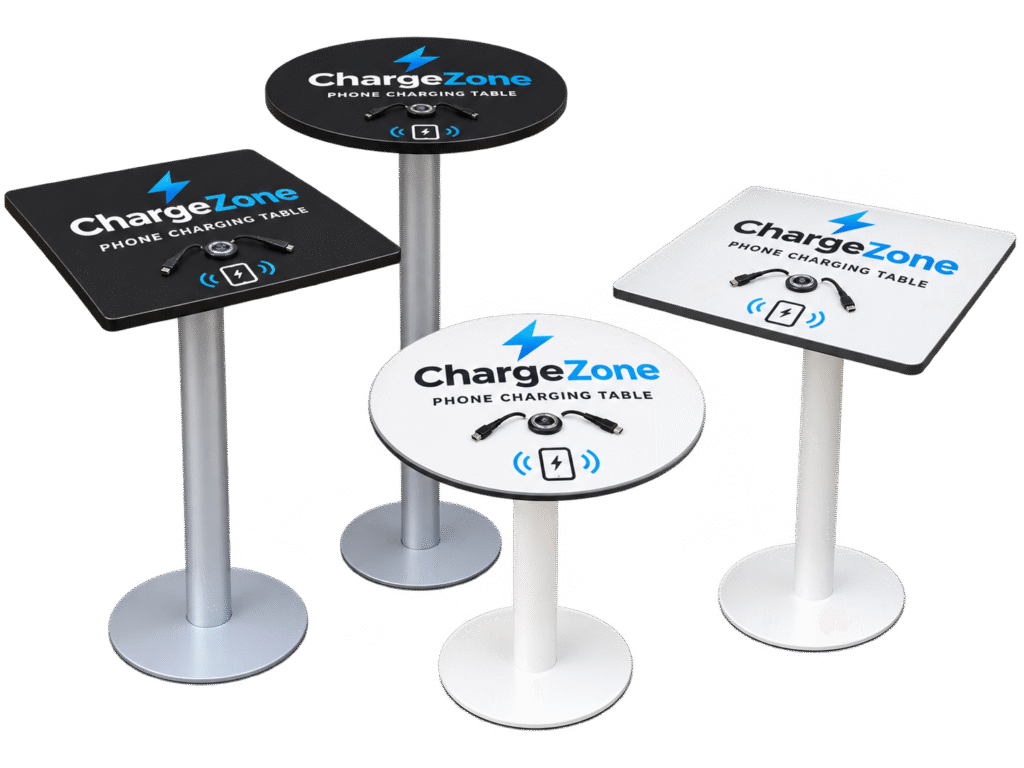
Chargezone powertable (phone charging table)
Designing a better visitor charging experience
A good charging experience begins before the visitor touches the equipment. People need to know the service exists, where it is and which format is available. Once they arrive, instructions should be legible and the area should feel orderly. If they need help, the route to assistance should be apparent.
Make the service easy to discover
Include charging in relevant visitor information. Add it to maps, apps, signs or host briefings where suitable. Use one consistent term, such as “Phone Charging” or a sponsor-led name followed by a clear descriptor. Avoid internal production labels that mean nothing to guests.
At a large event, directional signage can matter as much as branding on the unit. A sponsor may gain more useful exposure from several concise wayfinding mentions than from cramming extra copy onto the charging station.
Set accurate expectations
Describe lockers and open stations accurately. Explain that locker use follows the displayed access process and terms. For non-locker stations, remind visitors to remain responsible for their phones. Do not promise that a device will reach a particular battery level in a given period unless the supplier has provided a verified basis for that exact setup.
Similarly, avoid saying a locker makes a phone completely secure. The format can provide an enclosed compartment, but organisers should use cautious language and follow the agreed operating guidance.
Brief front-line teams
Registration staff, hosts, floor managers and sponsor representatives should know where charging is located. They do not need technical scripts, but they should be able to explain the difference between the available formats and direct operational queries correctly.
Include the service in the event briefing. Note who to contact if an instruction is unclear, a unit appears to need attention or a user raises an access question. A short, accurate briefing is more useful than leaving staff to improvise.
Review usage during the event
Event teams can observe whether a location is easy to find, whether a queue forms and whether visitors appear confused. Any adjustment must follow venue and supplier guidance; equipment should not simply be moved without agreement. However, signs, staff directions or surrounding furniture may sometimes be improved during the event.
Afterwards, record what worked. For recurring events, practical observations about location and peak periods can inform the next charging plan.
Making phone charging work harder for sponsors
A sponsor activation should create value without compromising the visitor service. Phone charging provides a strong foundation because the benefit is clear. The next step is to connect the sponsor to that benefit through design, communication and optional hosted engagement.
Give the activation a clear name
A simple name helps the event promote the service consistently. “Phone Charging, supported by [Sponsor]” is direct. A more campaign-led name may work if the charging function remains obvious. Use the chosen name on maps, signs and programme mentions.
The free sponsor-logo branding in the ChargeZone offer gives the physical units a consistent identity. Extend that visual treatment into approved event channels where appropriate.
Build visibility beyond the unit
Directional signs, digital agenda mentions and host announcements can extend the sponsor’s presence. An exhibitor may also promote charging in pre-event invitations or stand communications. These references should be useful, not repetitive.
If the charging location appears on a floorplan, make the marker legible. If it is mentioned in an app, provide a clear location. Every promotional touchpoint should help the visitor as well as recognise the sponsor.
Use dwell time respectfully
At an open station, sponsor representatives can offer a demonstration or conversation. They should also allow guests to charge without pressure. At lockers, a return visit can create a second contact point, but the retrieval process should remain efficient.
Any lead capture, competition or data collection should be separately explained and managed under the event’s relevant policies. Do not make the practical charging instructions dependent on marketing consent.
Measure what can be measured responsibly
Define success in terms appropriate to the activation. Useful evidence may include agreed photography, placement delivery, brand visibility and qualitative observations from staff. If the selected equipment or event process supports other reporting, confirm what is actually available before promising it to the sponsor.
Do not invent impression figures by multiplying attendance by assumed views. A credible post-event account is more valuable than an inflated number that cannot be supported.
Hiring versus buying phone charging equipment
Buying may make sense for an organisation with a stable, frequent and well-managed requirement. Hire or rental may be better when demand changes by event, branding varies, storage is limited or delivery support is valuable. The decision should reflect total operational responsibility, not only how often a unit might appear on a calendar.
When hire is the practical option
Hire suits a defined event at Allianz Stadium because the equipment can be matched to the floorplan, audience and campaign. The organiser does not need to create a permanent storage and maintenance plan for an item used occasionally. Event-specific branding can also be developed around the current sponsor.
Short-term hire is especially useful for agencies and production companies that deliver different briefs at different venues. It allows the charging mix to change between a conference, exhibition and outdoor programme.
When longer rental may suit
Long-term rental can suit a venue, organiser or brand with a continuing programme. It provides access over an extended period without necessarily taking the same route as outright purchase. The rental scope, branding, support and logistics should be discussed according to the intended use.
If equipment will move between events, clarify who is responsible for transport, setup, checks and storage at each stage. A long rental still needs operational ownership.
Questions to ask before buying
Before purchasing, consider where the equipment will be stored, who will inspect and manage it, how branding will be updated and whether the same format will suit future audiences. Also consider transport between sites and what happens when event plans change.
Ownership gives control, but it also transfers responsibility. For many one-off or variable events, a specialist hire arrangement keeps the solution aligned with the current brief.
Short-term phone charging station hire
Short-term hire is designed around a defined event period. It can cover an exhibition, conference, corporate function, hospitality day, festival-style event or brand activation. The equipment specification, artwork and delivery plan are tied to that occasion.
For event charging station rental at Allianz Stadium, start the conversation while there is still time to coordinate floorplans and artwork. No universal lead time should be assumed. Availability and production requirements depend on the actual order, so dates should be checked directly with ChargeZone.
What to include in a short-term hire enquiry
Provide the event name, venue space, public dates, access details and expected format. Explain whether the equipment will be organiser-provided, sponsor-backed or located on an exhibition stand. State whether you are considering lockers, standard stations or a mix.
Include the branding deadline if one has already been set, but ask whether it is workable. Name the artwork approver and on-site contact. If the event has an appointed production agency, connect the relevant teams early.
Making the most of a one-off event
A one-off event can still produce learning. Record which locations attracted demand, what questions guests asked and whether the mix of locker and non-locker stations suited the programme. Keep approved artwork files and activation photography where permitted. These materials can inform future briefs even if the venue or sponsor changes.
Long-term phone charging station rental
Long-term rental is relevant when charging is needed across a season, a programme of events or an ongoing visitor environment. The plan can still include sponsor or corporate branding, but the artwork may need a longer useful life than a single-event campaign.
A rental discussion should cover where the units will be used, how often they may move, who oversees them and what support is expected. If the requirement includes several event types, consider whether a mixed fleet of lockers and standard stations would be more flexible than relying on one format.
Recurring events and venue programmes
For a recurring conference series or exhibition calendar, rental can make charging a consistent amenity. Visitors and staff become familiar with its location and operation. The organiser can then refine wayfinding and briefing rather than rebuilding the service from the beginning each time.
Consistency should not prevent review. A unit that worked for one floorplan may need a different position for another. Sponsor artwork may require updating. Access and delivery plans can change. Treat each event as an operational check within the longer arrangement.
Brand planning over a longer period
Evergreen artwork may be suitable for a long rental, particularly when one organisation provides the service across multiple dates. If sponsors change, discuss how branding updates will be handled before committing to a design approach. Keep core charging instructions stable and separate from campaign copy where possible.
A practical planning guide for Allianz Stadium phone charging
A disciplined process makes the charging service easier to deliver. The following stages can be adapted for organisers, agencies, production teams, venue managers and exhibitors.
1. Define the purpose
Write one sentence that explains why charging is being hired. For example: “Provide a useful delegate amenity across a full conference day and give the headline sponsor a visible service-led activation.” This sentence will guide choices about format, quantity, location and branding.
Avoid starting with a product count before the purpose is clear. Two events with the same audience size may need very different solutions because one prioritises stand dwell and the other prioritises a central delegate service.
2. Map the visitor journey
Mark arrival, registration, main content, exhibition, refreshments, networking, hospitality and departure. Note where people pause and where they are likely to need their phones. If the event spans more than one level or room, consider the effort required to reach a central charging point.
Use the actual programme and floorplan. General assumptions about “high footfall” are less useful than knowing when a plenary empties or where lunch is served.
3. Select locker, non-locker or mixed provision
Choose lockers when guests may want to leave devices while continuing with the programme. Choose standard stations when open charging and nearby dwell support the experience. Use a combination when the event includes both behaviours.
Record the reason for each proposed unit. “Locker near delegate lounge for session-time use” is more actionable than “three units around venue”.
4. Estimate quantity and zones
Define the locations that need service, then discuss capacity with ChargeZone. Consider event duration, mobile-dependent activities, simultaneous breaks and travel patterns. Do not rely on an invented attendee-to-unit ratio.
Use the free additional locker and free additional standard station in the current offer to extend useful coverage. They may allow a satellite location, separate sponsor area or better format choice.
5. Check the floorplan and venue requirements
Place each unit on the working plan and review it with the people responsible for operations, electrical planning, access and safety. Confirm that it will not obstruct routes, doors, catering or sightlines. For an exhibition stand, include it in the relevant stand documentation.
For outdoor use, confirm equipment suitability and environmental arrangements specifically. Do not assume an indoor plan can be transferred outside.
6. Develop the branding
Decide whether the event, sponsor or exhibitor is the lead identity. Provide correct files and simple copy. Ask the designer to preserve clear charging instructions and legibility. Establish one approval route.
Take advantage of the offer’s free sponsor-logo branding, but do not rush sign-off. Check spelling, logo version, colours and any required acknowledgements.
7. Agree delivery and collection
Share the access schedule, loading information supplied by the event team, venue contact and final location. Confirm the delivery arrangement with ChargeZone rather than assuming that a broad build day is enough information.
Add the equipment to production schedules and contact sheets. Plan collection or post-event handling with the same care as delivery.
8. Prepare wayfinding and communications
Decide how visitors will discover the service. Options may include floorplans, apps, emails, digital screens, signs and staff directions. Use consistent naming and location descriptions.
If a sponsor is involved, agree which mentions form part of the package. Ensure every mention helps the visitor find or understand the charging service.
9. Brief staff and hosts
Explain where each unit is, which type it is, and who handles questions. Remind teams not to make unsupported claims about speed, compatibility or security. Provide the supplier or production escalation route as appropriate.
Sponsor hosts should understand that the service comes first. They can welcome users and begin conversations without making charging feel conditional.
10. Check the live environment
Before opening, confirm that units are in agreed positions, artwork is correct, instructions are visible and surrounding areas are tidy. Check that signs point to the right place. Any operational check should follow supplier guidance.
During the event, observe queues, wayfinding and user questions. Do not move equipment independently if the position has been agreed as part of the production plan.
11. Review after the event
Collect feedback from floor managers, hosts and the sponsor. Note peak periods, popular locations and recurring questions. Record any changes that would improve a future event.
If the charging formed part of a sponsorship package, report the agreed deliverables honestly. Use photographs only where permissions and event policies allow.
Why choose ChargeZone for Allianz Stadium events?
ChargeZone is a specialist UK supplier of phone charging lockers and standard non-locker charging stations. Its offer spans short-term hire and long-term rental for exhibitions, conferences, corporate events, festivals and other live environments. Custom and sponsor branding, flexible delivery and professional support allow the charging plan to be shaped around the event rather than treated as a generic add-on.
A choice of charging formats
The availability of both locker and non-locker stations helps planners respond to different visitor behaviours. You can create a managed destination, an open social charging point or a combined network across the event.
This choice is particularly valuable at a flexible venue such as Allianz Stadium, where a conference, exhibition, hospitality programme and outdoor event can require very different layouts.
Event-focused hire and rental
Short-term hire supports one-off and campaign-specific activity. Long-term rental supports recurring or ongoing requirements. Organisers can discuss the term that matches the brief rather than being pushed towards ownership by default.
Branding that supports sponsors
Custom artwork turns the station into part of the event identity. The current offer makes sponsor integration especially attractive by including free branding featuring the sponsor’s logo. This can help organisers create a service-led package with clear physical presence.
Flexible delivery and professional support
Event logistics require coordination. Flexible delivery helps align the equipment with the agreed schedule, while professional support gives organisers a specialist contact for product choice, branding and practical planning. Exact arrangements should always be confirmed for the event.
An offer that adds both formats
The free additional locker and free additional standard station add more than raw quantity. They broaden the plan. An organiser can support guests who want compartment-based charging and those who prefer an open station, while using the two formats in different zones.
Frequently asked questions on Event Phone Charging Station Hire and Rental at Allianz Stadium, Twickenham
Is Twickenham Stadium now called Allianz Stadium?
Yes. Twickenham Stadium is now officially Allianz Stadium. Event materials should use the venue’s current official name, although including “Twickenham” remains helpful for geographic clarity and for guests who know the venue by its former name.
Can I hire phone charging stations for an event at Allianz Stadium?
Yes. ChargeZone supplies charging lockers and standard non-locker charging stations for short-term event hire. Provide the event date, space, format, access details, audience journey and branding requirements so the team can discuss a suitable plan.
What is included in the current ChargeZone offer?
The offer is: order today and receive free branding featuring your sponsor’s logo, a free additional phone charging locker, a free additional standard non-locker phone charging station, and free flexible delivery. Ask for all elements to be shown clearly in the order discussion so the operational and artwork plans reflect them.
What is the difference between a charging locker and a standard charging station?
A charging locker places a device in an individual compartment under the agreed access process. A standard non-locker station provides open charging, with the visitor normally remaining nearby and responsible for the device. Confirm the exact operating method of the selected equipment with ChargeZone.
Are charging lockers secure?
A locker provides an enclosed compartment and controlled access according to the selected unit’s operating process, but organisers should not advertise absolute security. Users should follow the displayed instructions and terms. The event plan should include appropriate oversight and a clear route for questions.
Do visitors leave their phones at a non-locker station?
A non-locker station is intended for open charging, and visitors would normally remain with or close to their devices. Instructions should make user responsibility clear. Organisers should place the station in a suitable, visible area rather than encourage unattended phones.
Which option is best for an exhibition?
It depends on the objective. Open stations can support dwell and conversation on a stand or in a networking area. Lockers can provide a central service that lets visitors continue around the show. A mixed plan often works well for larger or longer exhibitions.
Which option is best for a conference?
Lockers can suit delegates who want to charge during a session. Standard stations can support breaks and networking when guests keep phones with them. Review the agenda, room layout and use of event apps before choosing.
Can an exhibitor hire a station for an individual stand?
Yes. A charging station can be planned as part of an exhibition stand, subject to organiser, venue and stand requirements. Include it in the floorplan and electrical planning where required, and allow enough room for users without obstructing the aisle.
Can the charging stations carry sponsor branding?
Yes. ChargeZone offers custom and sponsor branding, and the highlighted offer includes free branding featuring the sponsor’s logo. Supply approved artwork and identify the person responsible for sign-off.
How should sponsor branding be designed?
Make the charging service immediately obvious, then present the sponsor identity clearly. Keep operating instructions separate from campaign copy. Use strong contrast, concise wording and approved logo files. Avoid filling every surface with text.
Where should stations be placed at Allianz Stadium?
Potential areas include organiser hubs, networking spaces, refreshment zones, conference foyers, hospitality lounges and exhibition stands. The final position must reflect the actual floorplan and be agreed with relevant venue and production contacts. Avoid circulation routes, entrances and service areas where queues or dwell could cause problems.
Can charging stations be used in the Rose Suite?
They can be considered as part of an event plan for the Rose Suite. The suite provides 1,180 m², but the appropriate locations and quantities depend on the layout and programme. Review positions with the venue and event team.
Can charging stations be used in the Live Room?
They can be considered for events in the 440 m² Live Room, subject to the specific setup and relevant approvals. A concentrated layout may make one well-positioned charging zone effective, but the final recommendation should follow the event brief.
Can phone charging support outdoor events at Allianz Stadium?
The venue has outdoor space suitable for large exhibitions and festival-style events. Charging may be considered, but outdoor use requires explicit review of equipment suitability, shelter, weather, ground conditions, power, supervision and venue requirements. Do not assume an indoor unit can be installed outside.
How many charging stations do I need?
There is no universal ratio. Consider event duration, phone-dependent activities, room spread, break patterns, dwell time and whether you want locker and non-locker choice. Share these details with ChargeZone for a tailored recommendation.
Can the extra free units go in different areas?
That can be discussed as part of the floorplan and delivery plan. Separating the additional locker and non-locker station may extend coverage and serve different behaviours. Every position still needs the relevant operational approval.
What does free flexible delivery mean for my event?
It means delivery can be planned with flexibility around the agreed event arrangements as part of the offer. Provide accurate access information, dates, contacts and locations, then confirm the final plan with ChargeZone. Flexibility works best when logistics are communicated early.
How far in advance should I order?
No single lead time should be assumed. Equipment availability, branding and delivery planning depend on the brief. Contact ChargeZone as soon as the requirement is known, especially if sponsor artwork or a complex access schedule is involved.
Can ChargeZone work with our production company or agency?
Yes. The charging brief can be coordinated with the appointed event, agency or production contacts. Establish who approves branding, who controls the floorplan and who manages venue access so decisions reach the correct person.
Can phone charging be included in a sponsorship package?
Yes. Define the unit types, planned locations, branding, wayfinding mentions and any hosted element. Present the package as a useful visitor service with visible sponsor support. Avoid guaranteeing impressions, leads or usage levels that cannot be substantiated.
Is charging suitable for corporate hospitality?
Yes. Lockers and open stations can support hospitality guests, provided the format and placement match the environment. Use considered branding, brief hosts and integrate the unit with the room design rather than treating it as an isolated utility.
Can I rent charging stations for a longer period?
Yes. ChargeZone offers long-term rental as well as short-term hire. Discuss the event calendar, intended locations, movement between spaces, branding life and operational ownership before choosing the term.
Should I hire or buy charging equipment?
Hire is often suitable for one-off events, changing formats and campaign-specific branding. Rental can support a longer programme. Buying may suit frequent, stable use when the organisation is ready to manage storage, transport, checks and branding updates. Compare responsibilities as well as frequency.
Will a charging station guarantee that a phone is fully charged?
Do not promise a particular result without a verified basis for the selected equipment, device and time available. Charging outcomes can depend on several factors. Describe the service as an opportunity to charge or top up, and confirm any product-specific guidance with ChargeZone.
What information should I send with an enquiry?
Send the event name, Allianz Stadium space, dates, access schedule, public opening periods, format, estimated audience profile, floorplan status, proposed charging zones, preferred unit types and branding objective. Add the artwork approver, production contact and on-site contact if known.
Can charging be promoted in the event app or floorplan?
Yes. Including the location in event information can improve discovery and extend sponsor visibility. Use the same activation name everywhere and provide an accurate location description. Coordinate any app, website or print deadlines with the overall campaign schedule.
Who should supervise the charging area?
The answer depends on the event and equipment format. A visible organiser, host or sponsor presence can help, particularly at busy points. Agree responsibilities with ChargeZone and the event team, and make sure front-line staff know where to direct operational questions.
Is phone charging useful even if the event is only one day?
Yes. Guests may arrive after travelling or using their phones earlier, and a full event day can involve tickets, apps, messages, photographs and onward travel. A one-day event can benefit from charging when the audience journey makes it relevant.
Request phone charging station hire for Allianz Stadium
If you are planning an exhibition, conference, corporate event, hospitality programme, sponsor activation or festival-style experience at Allianz Stadium, speak to ChargeZone about a charging plan built around the real event journey. Share the venue space, floorplan, programme, access schedule and branding objective. The team can help you consider phone charging lockers, standard non-locker stations, short-term hire or long-term rental.
Most importantly, ask for the current organiser offer when you enquire:
Order today and receive free branding featuring your sponsor’s logo, a free additional phone charging locker, a free additional standard non-locker phone charging station, and free flexible delivery.
Use the additional units to improve coverage, give visitors a choice of charging formats or create a stronger sponsor presence across the event. With clear placement, accurate messaging and coordinated logistics, phone charging can become a simple but valuable part of the Allianz Stadium experience.
Contact ChargeZone to discuss event phone charging station hire at Allianz Stadium, Twickenham