
The Business Case for a Phone Charging Station at Your Event Booth
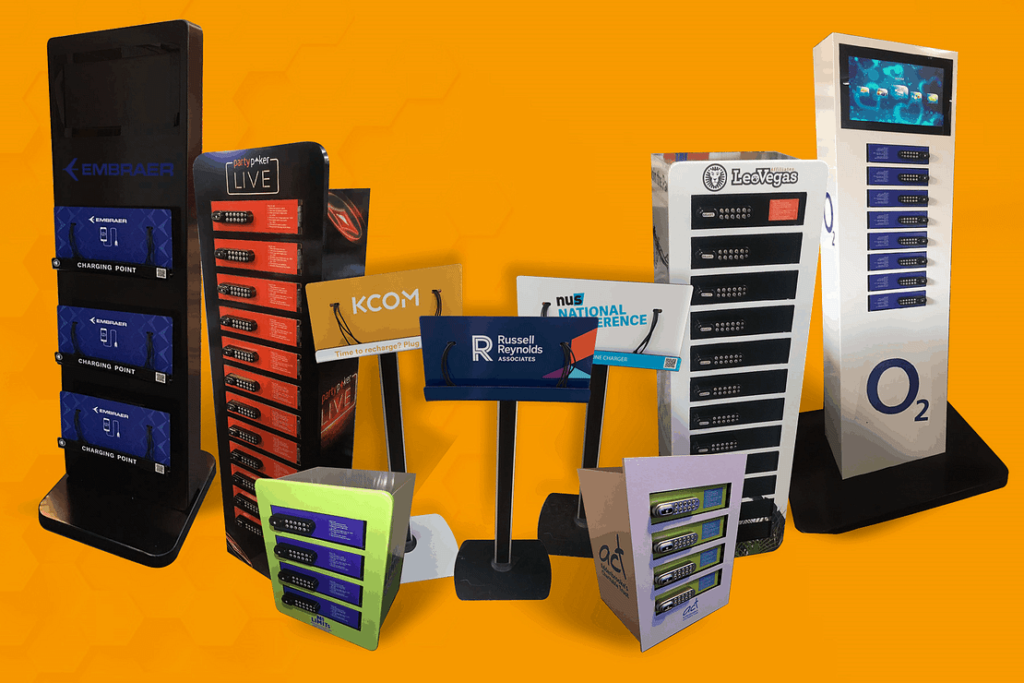
Chargezone Phone Charging station
Executive summary
A phone charging station is easy to dismiss as a convenience: a few cables, a locker unit or a charging table that helps a visitor keep a phone alive. But the commercial question for an exhibitor is not whether a charger is useful. It is whether a deliberately designed visitor service can create another reason for the right people to approach, remain in and interact with the stand.
A phone charging station for events may support a chain of commercial opportunities. A useful service can give an attendee a reason to stop. A clear, welcoming experience can make a first conversation less sales-led. A place to wait can make a demonstration, a question or a useful exchange easier to fit into the visitor’s day. Branded equipment, a QR code or a sponsor-funded charging lounge can add communication space to the physical environment.
Every link in that chain depends on the event, the audience, the stand location, the equipment and the way the team runs it. A charging station does not guarantee more qualified visitors, longer conversations, leads or sales. It is an enabler, not a substitute for relevant offers, good stand design, prepared staff or rigorous follow-up.
That distinction matters. The case should not be built on a vendor’s promise of guaranteed leads. It should be built on the opportunity cost of giving visitors no practical reason to stop, then on a measured trial that tests whether a charging experience improves the exhibitor’s own results.
This article follows five stages: diagnose what a stand without visitor utility may be missing; reframe charging as engagement infrastructure; quantify the potential cost of doing nothing with transparent illustrative assumptions; map a charging experience to specific stand problems; and close with a low-risk 50%-off trial offer.
Introduction: the hidden cost of an empty booth
An exhibition stand can look busy before the doors open. The graphics are installed, the screens are running, product samples are in place and the sales team has arrived. Then the hall fills. Attendees move from meeting to meeting, scan the aisles and make quick decisions about where to spend a limited amount of time.
Some stop because they already know the brand. Others have an urgent problem to solve, are drawn in by an impressive demonstration, or have booked a meeting. Many will pass without stopping. The stand’s cost, however, is not limited to the square metres and the build. It includes the planning, staffing, travel, promotion and opportunity cost of being in the hall at all.
That is why the relevant question is not simply, “What does an exhibition booth charging station cost?” Ask instead: “What did we invest to be here, and what additional opportunities could make that investment work harder?”
An unoccupied stand is an obvious problem. A stand that is technically staffed and visually attractive but gives a passer-by no compelling reason to pause can be a quieter one. Staff may be ready to talk, but the attendee has no immediate need to speak with them. The display may communicate the offer, but nothing in the visitor’s experience bridges the distance between looking and engaging.
A phone charging kiosk will not repair a weak proposition or an inattentive team. It can, however, introduce a practical service into a space that otherwise asks the visitor to make the first move. The potential commercial value lies in that extra opportunity, not in the socket itself.
Why event exhibitors compete for attention
An exhibition floor is a choice-rich environment. Attendees may have a packed agenda and a long list of exhibitors to visit. Even where attendance is strong, footfall past one particular stand is not the same as engagement with it. A person walking by is an impression of uncertain quality; a person who stops, asks a question or watches a demonstration is a more meaningful interaction.
The exhibitor is competing for several things at once: visibility in the aisle, a moment of attention, permission to begin a conversation, enough time to explain a relevant benefit and, where there is a fit, a next step. Those outcomes are related but not interchangeable. A QR scan is not necessarily a qualified lead. A lead is not necessarily a sales opportunity. A busy stand is not necessarily a profitable one.
CEIR, the Center for Exhibition Industry Research operated by IAEE, publishes work covering attendee and exhibitor reports, marketing insights, event performance metrics and retention or return-on-investment topics. Its 2024 series on maximising attendee and exhibitor engagement was designed to examine which approaches are working and how well they support specific exhibitor objectives; its stated scope is North American organisers and exhibitors. This is useful context, not proof that any one attraction—charging included—will deliver a particular uplift. Exhibitors should test tactics against their own audience and objectives.
The practical implication is straightforward: a stand needs more than exposure. It needs a reason to earn interaction. Stand design, relevant content, pre-booked meetings, staff behaviour and product relevance all contribute. A useful event phone charging station may contribute too, especially for an audience spending several hours in a venue and relying on a phone for event schedules, messages, tickets, travel and work. That is a reasonable planning hypothesis, not a claim that every attendee is low on battery or wants to stop.
The overlooked problem of smartphone battery pressure
Phones have become part of the event toolkit. An attendee may use one to display a digital ticket, check the event app, message colleagues, photograph a product, scan exhibitor information, arrange a meeting, respond to work and navigate their journey home. The more functions a phone serves, the more inconvenient it may be when its battery is running down.
This creates an easily understood service opportunity. The attendee does not need to be persuaded that a working phone is useful. They may already be looking for a safe place to recharge it, a spare cable, or a few minutes connected to power. At an all-day conference, a trade show or a multi-venue event, a clearly signposted charging point could meet a real need at the point it arises.
But need should not be confused with commercial value. Someone who wants to charge may be a buyer, a partner, a student, a supplier, a competitor or simply an attendee passing time. Some visitors may not need to charge. Some may plug in and leave. Some may prefer not to hand over a device or share personal information. An effective programme plans for those preferences instead of assuming that every charging user is a prospect.
The point is not that battery pressure automatically creates pipeline. The point is that it offers a practical, low-friction reason to enter a branded space. Whether that reason becomes a meaningful interaction depends on what happens next.
Step 1 — Diagnose: four problems a stand may be leaving unresolved
Before choosing a phone charging station, diagnose the job it is expected to do. If the actual issue is poor stand location, an irrelevant offer, too few trained staff or a weak lead follow-up process, charging alone will not solve it. If the issue is that passers-by have few reasons to approach and visitors who do arrive have little reason to stay, a useful service may be worth testing.
The following are not guaranteed consequences of operating without a charger. They are commercial risks that an exhibitor can check against its own observations and event data.
Problem 1 — Not enough booth traffic
Visitors have finite time and attention. On a crowded floor, they choose among familiar brands, scheduled meetings, compelling demonstrations and stands that appear immediately relevant. A company with attractive graphics and a credible product may still struggle to prompt a first interaction if the visitor cannot quickly see why stopping would benefit them.
Consider the difference between a display that says, in effect, “Here is what we sell”, and an invitation that says, “Here is something useful you can do here”. The first relies on the attendee’s existing interest in the product. The second creates an additional reason to approach, even if the attendee has not yet decided whether the product is relevant.
A phone charging station can be a traffic-generation mechanism in that limited sense: it provides a recognisable service that can be advertised before and during the event. A sign reading “Phone charging here” is immediately understood. The value of the sign is not its footfall count on its own. The value is the opportunity to create an appropriate first contact and then discover whether the visitor has a business need.
Without a utility or other compelling activation, the stand may have fewer natural opening moments. Staff then bear more of the burden of stopping visitors, and the approach can feel more sales-led. A charging facility may create a new invitation, but the stand still needs qualification discipline. More people through the footprint are only useful if the team can serve them without neglecting target accounts.
Problem 2 — A more difficult first interaction
A visitor who has not asked for a sales conversation may be reluctant to be intercepted by a pitch. A familiar opening such as “Can I help you?” can be well intended, but it also asks the attendee to decide whether they want help before they have identified a reason to stay. If they are only browsing, a quick “No, thanks” is an easy exit.
Compare that with a service-first invitation:
“Would you like to charge your phone while you’re here?”
The offer is concrete. It gives the visitor control and does not require them to show interest in the product. If the answer is yes, staff can welcome them, explain how the charger works and, where appropriate, ask an open question about their day.
That can change the brand’s first impression. Helpfulness and hospitality are not created by equipment alone; they are expressed through the way it is offered. Clear instructions, an accessible layout, an honest explanation of any security arrangements and staff who do not pounce on every user can make the service feel respectful. Conversely, a cluttered power strip, a broken cable or an aggressive pitch can make a nominal convenience feel inconvenient.
The opportunity is therefore not “charging equals better service”. It is that a relevant, well-run service may give staff a more natural opening to demonstrate customer care. The effect should be assessed through visitor feedback and observed interaction, not assumed from the presence of the kiosk.
Problem 3 — Too little time for a meaningful conversation
Getting someone to stop is only the beginning. The commercial value usually depends on what the right visitor does next: discuss an operational problem, watch a demonstration, meet a specialist, compare options, exchange contact details or agree a follow-up.
A hurried interaction can be too short to uncover need. A visitor may glance at a product and continue on their route. A stand team may deliver a rehearsed pitch before understanding the attendee’s role. The stand may register a badge scan but fail to record why the person engaged or what should happen afterwards.
A charging facility may give someone a reason to remain within the stand environment for a time. That creates a possibility—not a right—to offer a conversation, a demonstration or a useful piece of content. The visitor is not captive. They may sit quietly, leave as soon as the phone has enough charge, or decline any discussion. A strong experience makes engagement available without making it compulsory.
The metric to watch is not simply the total time a phone is plugged in. It is the quality and relevance of the human interaction during that time. A long wait with no staff attention is not a sales result. A short exchange with a well-qualified buyer may be more valuable than a long, unfocused conversation.
Problem 4 — Marketing and sponsorship space left unused
A charging station occupies physical and visual space. If it is anonymous, poorly positioned or difficult to use, it is merely equipment. If it is designed as part of the visitor experience, it may also become a small media environment: a branded locker door, a message on a screen, a clear call to action, a product demonstration nearby, a QR code linking to a resource, or a lounge supported by a sponsor.
This is what “turning dead space into marketing inventory” should mean in practice. It does not mean covering every surface with logos or treating every person who charges as an advertising impression. It means asking whether the charger’s footprint can convey useful information without obstructing the experience.
Possible elements include a branded charging table, well-placed wayfinding, sponsor recognition, a screen showing a product clip, a QR link to a technical guide, an opt-in competition or a prompt to book a demonstration. Each has a different purpose. A QR scan measures a scan, not purchase intent. A displayed sponsor mark is an exposure opportunity, not a guaranteed brand lift. A campaign form must have a transparent purpose and comply with applicable privacy and marketing rules.
A stand without charging can still create excellent marketing and sponsorship opportunities by other means. The missed opportunity is not a certainty that would otherwise become revenue. It is the possibility of additional physical inventory that an exhibitor or organiser could package, test and price.
A fifth diagnostic: sponsorship that stops at the logo
Many sponsorship packages include visible assets, but visibility on its own does not explain how an audience will interact with the brand or how the sponsor will assess the result. A branded charging lounge could give a sponsor a defined place in the attendee journey, with agreed rights, audience fit, service standards and reporting. It can also fail if it is hidden, poorly maintained or unrelated to what the sponsor wants to achieve.
Sponsorship measurement guidance from the Marketing Accountability Standards Board (MASB), presented in Sponsorium’s accountability series, emphasises linking the business case, activation and measurement, and notes the limitations of treating all impressions as equally valuable. That is a useful discipline for a charging asset: agree what will be counted and what those counts mean before selling the package. A logo impression, a charging session, an opted-in lead and a sponsor-attributed sale are distinct outcomes.
Step 2 — Reframe: a charger is not the product; engagement is
The wrong question is: “How much does a charging station cost?” The better question is: “What is a qualified visitor worth to us, and what could one additional meaningful conversation contribute?”
That does not make cost irrelevant. It puts cost alongside the opportunity it is intended to create. For an exhibitor already spending on stand design, graphics, furniture, lighting, AV, hospitality, giveaways, staff and travel, the comparison is not between a charger and nothing. The comparison is between another line of equipment and an investment in engagement infrastructure that may help the rest of the stand work harder.
Traditional booth investment establishes the environment. Engagement infrastructure gives people reasons to enter, remain, interact, return or remember. A phone charging station cannot replace the stand’s core commercial proposition. It should complement it, just as comfortable seating, a useful demonstration or good wayfinding can complement it.
Reframing also makes the test more precise. Instead of trying to prove that “charging works”, ask whether a particular activation performed a particular job at a particular event. Did it bring relevant people into the space? Did it make staff conversations easier to begin? Did the visitor experience improve? Did the team record useful next steps? Was there sponsor value? Which costs were incremental?
There are several questions worth answering before procurement:
•How much is an additional, qualified visitor worth to the business, after probability and margin are considered?
•What is another ten minutes of relevant prospect engagement worth to the sales team—and how will we tell relevant from incidental time?
•What could additional booth traffic contribute to pipeline if the team has capacity to serve it?
•What physical marketing inventory are we leaving unused, and would an audience or sponsor value it?
•What is the opportunity cost when a competing stand offers a useful service and ours offers no comparable reason to stop?
These questions do not presume that a charger will produce a return. They define the assumptions a trial needs to test.
Step 3 — Quantify the potential cost of doing nothing
A credible business case quantifies both sides: the additional investment required to create the charging experience and the value that might follow if it attracts and engages visitors. The difficult part is separating correlation from contribution. Visitors who use a charging station may have stopped anyway. A logo may be seen without being remembered. A conversation may produce a lead that would have been captured through another route.
For that reason, the model below is not a forecast, an industry benchmark or a promise. It is an illustrative framework for making assumptions explicit. Replace each input with your own event data, track the charging experience separately where practical, and compare results with an appropriate baseline.
Illustrative financial model
Assume a hypothetical one-day exhibition with 12,000 attendees. The stand team estimates that 4,000 people pass its frontage. Without an event charging station, 240 of those passers-by enter the booth’s engagement area during the day. This represents an assumed six per cent pass-by-to-visit rate. These are example figures only; they are not sourced benchmarks.
For simplicity, “additional visitors” below means visitors the team believes arrived because of the charging activation, over and above its expected baseline. Attribution is hard. Use a consistent counting rule, staff observation and a short visitor question such as “What brought you over?” rather than crediting every person who walks past a charging sign.
“Expected contribution per qualified lead” is also an assumption. It should reflect the exhibitor’s own historical close rate, typical gross contribution and time horizon, not the full face value of an opportunity in the CRM. For example, if a qualified lead has an estimated 10% chance of becoming a sale and the expected gross contribution from that sale is £3,000, the simple probability-weighted contribution is £300 before other costs. In practice, calculate this from your own data and avoid double-counting revenue already attributed elsewhere.
The example scenarios use the following formula:
Additional visitors × staff-engagement rate × lead-conversion rate × expected contribution per qualified lead = illustrative incremental lead contribution
They estimate extra engagement time separately:
Additional visitors × average incremental dwell time = additional visitor-minutes
Any sponsorship contribution is modelled separately. An exposure count is not itself revenue. Only include sponsorship cash or an agreed, defensible value in the financial return, and only where the asset is genuinely sold or funded.
Three hypothetical scenarios
| Assumption or outcome | Conservative | Mid-range | High-engagement |
| Additional visitors attributed to charging | 60 | 150 | 300 |
| Share having a meaningful staff interaction | 20% | 35% | 45% |
| Estimated meaningful interactions | 12 | 53 | 135 |
| Share of those interactions becoming qualified leads | 25% | 30% | 35% |
| Approximate qualified leads | 3 | 16 | 47 |
| Expected contribution per qualified lead (illustrative assumption) | £100 | £300 | £600 |
| Illustrative lead contribution | £300 | £4,800 | £28,200 |
| Hypothetical sponsor contribution, if secured | £0 | £2,000 | £5,000 |
| Illustrative service investment | £1,500 | £2,000 | £3,000 |
| Illustrative net incremental value before internal labour and other costs | –£1,200 | £4,800 | £30,200 |
| Average additional dwell time per attributed visitor | 4 minutes | 8 minutes | 12 minutes |
| Additional visitor-minutes | 240 | 1,200 | 3,600 |
All visitor counts, conversion rates, contribution values, sponsor income and costs in this table are invented assumptions for demonstration. They are not quotations, market prices or predicted results. The conversion formula produces fractional lead estimates in the mid-range (15.75) and high-engagement (47.25) cases. For readability, the table rounds these to 16 and 47 whole leads, respectively, and calculates the displayed lead contribution and net value from those rounded counts: conservative £300 + £0 − £1,500 = –£1,200; mid-range £4,800 + £2,000 − £2,000 = £4,800; high-engagement £28,200 + £5,000 − £3,000 = £30,200. A working business case should use exact values internally and state its rounding rule. These examples have deliberately not included internal staff time, floor-space opportunity cost, extra power, freight, storage, insurance or any broader stand expense. Add those to your own model. The apparent return can change materially when they are included.
The conservative case matters. It shows why buying a station and expecting it to pay for itself automatically is not a sound plan. If only a small number of people use it, few speak with staff, and no sponsor supports the asset, the investment may not be recovered in that event. The point of measuring is to learn that before repeating the expense.
Read the scenarios as a decision tool, not a sales forecast
The mid-range example does not mean a typical event will generate 150 extra visitors. The high-engagement example is not a likely outcome merely because the equipment is branded. It describes what the arithmetic would look like if those assumptions happened to be true. A real estimate should draw on comparable event history, the expected audience, stand placement, the service capacity and the quality of staff engagement.
Three kinds of value should be kept distinct:
1.Commercial value: qualified leads, sales opportunities, pipeline and, later, attributable gross profit.
2.Experience value: visitor feedback, perceived helpfulness, ease of use and willingness to recommend or return.
3.Media or sponsorship value: verified service sessions, exposure opportunities, QR activity or contracted sponsor contribution.
Do not turn each category into pounds and add them together unless the values are genuinely distinct. A lead that is later counted as sales pipeline and again as sponsor value is not two independent benefits. Nor should the same impression be valued once as sponsor inventory and again as brand awareness revenue without a defensible method.
What could opportunity cost look like?
Suppose the team has the capacity to conduct 40 useful prospect conversations in a day, but current stand behaviour yields 28. A new visitor service might create more opportunities to meet that capacity. If it does, the business case could be meaningful. If the team is already at capacity and qualified buyers are waiting, adding general footfall may make service worse. If the stand attracts many people who are not relevant and there is no plan to welcome them efficiently, it could even distract the team from priority accounts.
The cost of doing nothing is therefore not “the sales you certainly lose by having no charger”. It is the value of the additional, relevant interactions you could have tested but did not create. That value may be zero in some settings. It may be substantial in others. The only defensible way to know is to measure.
Illustrative comparison of booth measures
| Metric | Without a charging activation | With a charging activation | Potential commercial implication |
| Booth visitors | Example baseline: 240 | Example baseline plus 60–300 attributed visitors, if observed | More chances to identify relevant attendees; not all will be prospects |
| Average dwell time | Example: 3 minutes | Example: 7–15 minutes for a subset of users | Potentially more time for content or conversation; average should exclude unattended charging time if the goal is staff engagement |
| Meaningful conversations | Example: 28 | Could increase if suitable visitors stop and staff have capacity | More discovery opportunities, subject to qualification and follow-up |
| Leads | Example: 8 | Could rise if interaction and lead quality are maintained | Potential contribution should be probability-weighted and sourced in CRM |
| Brand impressions | Stand graphics and normal footfall | Additional exposure surfaces or sponsor touchpoints may be available | Count verified opportunities; do not equate them with recall or sales |
| Sponsorship inventory | Existing stand rights | An optional branded charging point or lounge could be packaged | Potential revenue only if a sponsor agrees to pay or fund it |
Every number in this comparison is illustrative. It shows what to measure, not an evidence-backed promise that an event charging station will produce these differences.
Step 4 — Match the solution to the problem
The charging experience should be designed around the problem it is meant to address. A unit hidden behind a counter will not create a visible reason to stop. A wall of branding with no clear instructions will not feel helpful. A station placed in the centre of a stand without staff, seating or a clear path may obstruct traffic rather than improve it.
The useful-service chain is simple, but each step needs a deliberate choice:
Useful service → additional reason to approach → potential increase in traffic → opportunity for longer engagement → more conversations → potential additional leads → measurable marketing value → potential sponsorship inventory.
None of those arrows is automatic. The charging station creates an opportunity; the way the exhibitor integrates it determines whether that opportunity is useful.
Pain 1: not enough reasons to stop
A charging point can provide an immediately understandable reason to approach. Help attendees recognise it before they arrive at the stand. Use concise signage at aisle height, a message in pre-event communications where appropriate, a listing in the event app if the organiser permits it, and consistent social posts. Keep the call to action literal: “Phone charging here” is clearer than a vague slogan.
Where floor graphics are permitted, use them to guide people without obstructing access or creating trip hazards. If an event app supports exhibitor listings, make the charging service visible there. If staff are inviting visitors in person, they should sound welcoming rather than transactional: “You’re welcome to top up here” is more service-oriented than “Come in for a sales pitch and a free charge”.
A charging lounge may suit a larger stand or an organiser-led activation. Branded charging tables or lockers may suit a smaller footprint. The right format depends on throughput, security preferences, the number and type of devices, power availability, access requirements and the event’s technical rules. Confirm venue approvals, electrical requirements and the provider’s operational terms before committing.
Integrate charging into a wider traffic strategy. Plan the relationship between the unit and the main demonstration, the meeting area and any accessible routes. Tell staff which audiences matter most and how to make room for them if the station draws a queue. Promote the service as a visitor benefit, not as a promise that everyone will have a sales conversation.
Pain → solution Problem: There are too few reasons for an attendee to stop. Potential response: Offer a practical, clearly signposted service that gives another reason to approach, then make the next step optional and relevant.
Pain 2: a sales-first opening feels awkward
A charging station can shift the first interaction from a pitch to a service. Staff can offer help with the charging process, explain what devices are supported and then leave the visitor space to choose whether to engage.
A natural sequence might sound like this:
“Need a top-up? You’re welcome to charge your phone here.”“We have USB-C and Lightning cables; if you would rather keep hold of your phone, the charging table is over there.”“While it charges, what brings you to the event today?”
The last question is an invitation, not a requirement. Staff can follow the visitor’s lead. If the person is happy to talk, ask a broad question about their priorities and listen. If they prefer to sit quietly, let them. A short orientation to the stand or a one-page guide may be more useful than a pitch.
Training remains essential. Teams should practise how to greet users, handle a queue, protect personal space, spot accessibility issues and move a conversation towards a relevant next step without implying that service depends on a lead form. They should know when to disengage. A person’s phone charging session must not become a pretext for collecting data or applying pressure.
Pain → solution Problem: The first contact can feel like an unsolicited sales approach. Potential response: Begin by making the visitor’s immediate task easier. Ask permission before moving from service to business conversation.
Pain 3: limited dwell time for engagement
The visitor journey should have a clear beginning, a useful middle and an easy exit:
Arrive → charge → wait → explore → talk → engage → decide on a next step → leave.
The waiting period could be used for a short product demonstration, a relevant video, a technical explainer, hospitality, a networking introduction, a competition, a survey or a conversation with a specialist. A charging table might have a QR code to a case study. A display could show a live demonstration at set times so visitors can choose to watch while waiting. A hospitality area might let a visitor sit with their device while the stand team remains available nearby.
Offer activities at different levels of commitment. At the lowest level, the attendee can charge without speaking to anyone. At the next, they can browse a useful resource. They might then ask a question or watch a demo. Only after relevance is established should a staff member invite a deeper discussion, meeting or lead capture.
This protects the quality of the experience. Visitors should not feel trapped, monitored or obliged to provide contact details to use a basic service. If secured lockers are used, communicate clearly how they work, what security they do and do not provide and how a visitor retrieves a device. Make the station accessible to people with different mobility, sensory and charging needs, and provide a non-digital way to get assistance.
Pain → solution Problem: Visitors may leave before there is time for a substantive interaction. Potential response: Make a useful waiting environment where optional content and conversation are available, while preserving a clear, pressure-free exit.
Pain 4: missed marketing opportunities
Treat the charging point as a potential media asset, not a billboard that must carry every message. Prioritise a small number of tasks: identify the service, explain how to use it, reinforce the brand, and point interested visitors towards a useful next step.
Possible activation components include branded locker doors, charging tables, screen content, a sponsored lounge sign, concise product information, a QR code to a practical guide, an event-specific offer, a competition entry or a partner message. Any campaign should have a clear audience benefit and a clear measurement plan. If the goal is technical education, link to a technical asset. If the goal is meetings, offer a booking link. If the goal is sponsor exposure, agree the placement and count the delivery.
Keep visual identity and calls to action legible. A person whose battery is nearly empty may not want to navigate a long landing page. The station should remain functional even if screens or connectivity fail. Include a simple alternative for visitors who do not use QR codes, such as printed instructions or a staff member who can help.
Pain → solution Problem: Functional equipment consumes space but contributes little to the brand experience. Potential response: Design the charging area so its service, content and branding support a coherent visitor journey rather than adding clutter.
Pain 5: sponsorship opportunities not yet packaged
An exhibitor or event organiser might package a charging service as “Phone Charging Lounge sponsored by [Brand]”. A technology partner could support the equipment. A telecoms company might value an association with connectivity. A financial brand, consumer company, local business or strategic partner might support hospitality or a visitor benefit if the audience and objectives fit.
A sponsor proposal should specify the actual rights. For example: naming, logo placement, on-screen messages, QR-linked content, an agreed number of activations, a product demonstration or an opted-in engagement opportunity. It should also specify what is not included. A sponsor cannot assume access to personal visitor data just because it has funded a charging station. Data roles, permitted purposes and any sharing arrangement need to be agreed and explained transparently.
Price the asset based on audience relevance, location, expected service use, quality of execution, exclusivity and reporting—not an unverified impression multiplier. Sponsorium’s presentation of the MASB accountability work recommends setting key performance indicators against individual sponsorship assets and measuring performance against those indicators, while warning that exposure measures do not all carry equal value. That supports a more credible sales conversation: “Here is what the package includes, here is what we will count, and here is how we will report it,” rather than “This charger will generate a guaranteed return.”
Competitive analysis: two hypothetical exhibitors
Consider two businesses exhibiting at the same industry show. Their stands have a similar footprint, comparable product relevance and experienced staff. Both have clear graphics and a demonstration. One has no practical visitor utility. The other has an integrated phone charging station.
This comparison does not mean the charging booth necessarily wins. The location, offer, staff, audience fit and operational execution may matter more. The difference is that the second stand has created another potential entry point into its experience.
| Visitor or commercial dimension | Exhibitor A: no charging station | Exhibitor B: charging station integrated into the stand |
| Reason to approach | Product interest, planned meeting or visual appeal | The same reasons, plus a practical phone charging service |
| First interaction | Often begins with product browsing or staff approach | May begin with a welcome and help using the station |
| Visitor choice | Browse, speak or leave | Charge without discussion, browse, speak or leave |
| Dwell opportunity | Depends on interest in the display, meetings and hospitality | Those options remain, with an additional reason to stay nearby while charging |
| Staff opportunity | Team must create a reason to engage | Team can offer useful assistance before asking about business needs |
| Data opportunity | Standard badge scan or form where appropriate | Same methods; any added QR activity should have a stated purpose and opt-in where required |
| Brand surfaces | Stand graphics, screens, materials | Existing surfaces plus station, lockers, screens or charging lounge if thoughtfully branded |
| Sponsorship | Existing package | Possible additional asset to package, subject to rights, audience and sponsor demand |
| Operational demands | Stand staffing and maintenance | Also manage equipment, cables, queue, security, power, signage and service continuity |
| Main risk | Passers-by may not see a reason to stop | Visitors may use the service without being prospects; poor execution may create congestion or friction |
| Commercial result | Depends on execution | Also depends on execution; charging only creates added opportunities to test |
What the visitors might experience
At Exhibitor A, a visitor sees an attractive stand, glances at a product demonstration and continues to the next appointment. They may have had a genuine need for the product, but no question arises and no member of staff manages to start a conversation.
At Exhibitor B, the visitor sees a clear charging sign and approaches to ask whether the station supports their phone. A staff member explains the options and points to an accessible place to sit. The visitor checks a product display while waiting. A team member offers a short demonstration; the visitor accepts because the subject relates to a challenge they are working on. They exchange details or agree a follow-up. Another visitor uses the charger, declines discussion and leaves. Both outcomes are valid: the service was offered without coercion, and only one interaction became a commercial conversation.
The charging booth has not converted every attendee. It has added a practical reason to approach and another moment in which relevant engagement could happen. A well-run team can make that moment useful. A poorly run team can waste it.
Visitor journey comparison
Without charging
Walk past → glance → perhaps stop → receive a sales pitch → decide whether to continue → leave.
That journey can work when the attendee is actively seeking the product, has a scheduled meeting or is captivated by the display. It can be less effective when the attendee is uncertain about relevance, short on time or reluctant to initiate a conversation. If the first interaction is only a pitch, a visitor who is not ready to buy may have little reason to remain.
With charging
See a charging sign → approach the stand → choose a charging option → wait or sit → explore nearby content → interact if interested → have a conversation → watch a demonstration → opt into a next step if relevant → leave → potentially return.
The additional stages are opportunities, not required steps. The visitor may approach, charge and leave without speaking. They may talk but not be a lead. They may be a partner rather than a buyer. A successful experience does not depend on forcing every user through a funnel.
The outcome depends on booth design, staff behaviour, stand location, audience and event quality, equipment availability and the broader marketing plan. Treat the journey as a design hypothesis. Observe where people stop, what they do, how they respond and where they leave. Then improve the experience for the next event.
How to integrate charging into stand design
Choose the format around the visitor and the footprint
A charging locker can suit a visitor who wants to leave a phone secured while exploring the stand, but it also creates questions about access, security, instructions and operating responsibility. A charging table can make it easier for the visitor to retain the device, though cables and device compatibility need careful management. A dedicated lounge can support a longer experience and sponsor presence, but it requires enough space, seating and staff oversight.
Before choosing a format, establish the likely number of simultaneous users, the expected peak periods, device types, power requirements, venue rules and how faults will be reported. Ask whether people can use the service without downloading an app or surrendering personal information. Confirm the provider’s insurance, support arrangements, setup and removal responsibilities, and contingency if a unit fails. A charging activation should not create unmanaged electrical or trip hazards.
Place it where it earns attention without blocking flow
Locate the station where it is visible from the aisle but does not narrow an access route, obstruct the demonstration or create a queue across a neighbour’s frontage. Maintain clear routes for wheelchair users and attendees with mobility aids. Think about people carrying bags, using mobility equipment or needing a quieter place to sit. Keep signs easy to read and instructions available in an accessible format.
Design the surrounding area for more than one behaviour. A person should be able to approach, understand the service, connect a device, sit or stand comfortably, and leave without crossing through a sales conversation. If the charging zone is also used for meetings or product demonstrations, separate the functions so one does not disrupt the other.
Build the brand into the service, not over it
The brand experience is shaped by reliability, clarity and courtesy as much as by the logo. Branded charging lockers, a well-designed table or a sponsored seating zone can make the activation recognisable. Keep service instructions prominent. Make any access or return process straightforward. Avoid a sponsorship message so dense that the essential instructions disappear.
Plan for reliability
Test the station with a range of devices before the doors open. Check cables, connectors, locks, screens, QR destinations, network access and power. Have a named person responsible for maintenance, a spare-cable or fault process and a fallback message if the unit is temporarily unavailable. Ensure that a technical problem does not strand a visitor’s device or create confusion over who is responsible for it.
The less visible operational planning is often what protects the experience. If the unit fails during a busy period, a staff member should know what to say and what alternative is available. Clear expectations are more credible than promising uninterrupted service without a backup plan.
How sales teams should use the charging interaction
Make the service genuinely optional
The first priority is to deliver the service as advertised. Staff should explain the charging options and any relevant security limitations. They should not imply that a visitor must share their details, scan a QR code or sit through a product pitch to use the charger.
Ask, listen and qualify
When it feels appropriate, ask an open question: “What brings you to the event?” or “What are you looking to learn about today?” These questions invite the visitor to set the direction. Listen for fit. If there is a potential need, ask a follow-up question about the problem, the current approach or the timeline. If there is no fit, provide a useful resource and let the visitor move on.
This approach protects staff time. Not every charging user should receive the same depth of sales attention. A team might use a simple routing model: welcome everyone; offer help to anyone who needs it; ask one optional discovery question; then invite a relevant prospect to meet a specialist. The rest can charge in peace or explore the stand independently.
Make the next step proportionate
Not every conversation needs a full lead form. A visitor might take a product guide, follow the brand’s event page, book a demonstration or agree to a post-show meeting. Record the next step that the person actually accepted. Do not label a casual chat a qualified lead simply because a badge was scanned.
CEIR’s exhibitor lead-quality guidance highlights the importance of improving the quality of leads captured and converting them into a clear next action or revenue, rather than treating collection alone as success. A charging activation should support that discipline. Record why the visitor engaged, what they need and what the sales team agreed to do next. Follow up in a timely, relevant way and compare lead quality with other stand interactions.
Protect the visitor’s data and trust
A QR code can link to a form, but a scan does not in itself establish marketing consent. Explain what information is being collected, why it is needed, who will use it and what communications a person is agreeing to receive. Make optional marketing choices clear and separate where appropriate. Do not make an attendee’s access to a basic charging service depend on unrelated marketing permission.
The UK Information Commissioner’s Office (ICO) advises organisations to plan direct marketing before starting, including the information they intend to use, what they will do with it, who is responsible for compliance and the lawful basis involved. Electronic marketing is also subject to specific rules. Requirements depend on the audience, channel and circumstances, so event teams should consult current ICO guidance and their privacy lead rather than assuming a badge scan or a QR interaction authorises every follow-up.
How sponsors can benefit
A charging station can give a sponsor a practical role in the event environment. That may be more appealing than an additional logo if the service fits the sponsor’s audience and brand. “Phone Charging Lounge sponsored by [Brand]” makes the connection visible and useful, while leaving the attendee free to use the facility without becoming a sales prospect.
The sponsor package could define:
•The service name and permitted brand treatment.
•The number and location of charging points or lounge zones.
•Approved screen content, printed messages or QR-linked resources.
•Any product demonstration or hospitality element.
•Whether the sponsor is present on-site and what staff may do.
•What activity will be measured and how the results will be reported.
•Data responsibilities and a clear prohibition on unapproved data sharing.
A technology partner might contribute equipment or technical support. A telecoms company could be a natural fit for a connectivity theme. A consumer brand might support a visitor lounge. A strategic partner might fund an activation that aligns with a target account audience. Local businesses may be interested where the event is local and the audience overlap is credible.
Commercial arrangements can include cash sponsorship, in-kind equipment, co-marketing or a shared activation budget. These are not equivalent. Record the actual cash contribution separately from an estimated in-kind value, and do not count a sponsor’s theoretical interest as revenue. A sponsor should receive a post-event report that distinguishes delivered rights, actual use, visitor feedback and any qualified engagement. That makes the asset easier to evaluate and, if it works, to renew or improve.
How to measure return on investment
A charging activation should be measured against its intended job. If its primary role is to create a new visitor service, count users and collect feedback. If the purpose is to create qualified conversations, instrument the staff interaction and lead quality. If a sponsor is funding it, report the contracted rights and delivery. Avoid using one proxy, such as total charges, as an all-purpose measure of marketing success.
The measurement plan should be agreed before the event. Decide what the baseline is, how the team will count activity, what constitutes an attributed visitor, how a meaningful conversation is defined, and how far into the sales cycle results will be reviewed. Give staff a simple way to tag charging-related interactions in the lead system. Where the technology permits, use anonymous session counts rather than collecting personal information simply to count usage.
Establish the baseline
Use the closest relevant comparison available. That could be a similar event where no charging station was present, a comparable day or time window, the same stand’s historical performance, or a controlled comparison between zones. There is rarely a perfect control group at a live event, so disclose the method and its limitations. A team may use a short question to ask visitors how they found the activation, but visitor recall is not a flawless attribution method.
Record the factors that could influence results: event attendance, audience profile, stand location, nearby attractions, weather or travel disruption, session timing, competing activations, staff headcount, pre-event promotion, demonstration schedule and changes to the product offer. Without these details, a before-and-after comparison can invite false conclusions.
Track a funnel, not a vanity number
The following measures make the chain of value visible:
| Stage | Example measure | What it tells you | What it does not prove |
| Awareness | Sign visibility, event-app listing, campaign reach | Whether the service was promoted | That a person saw, understood or remembered it |
| Approach | Unique visitors approaching the charging zone | How many people came to the area | That the station caused every approach or that visitors fit the target market |
| Use | Charging sessions or unique users, if reliably countable | Whether the service was used | That each session was a marketing impression or lead |
| Experience | Short optional feedback, ease-of-use observations, complaints | Whether visitors found the service helpful | That a positive comment will become a sale |
| Engagement | Conversations, demonstrations, content views, time in relevant interaction | Whether the activation created engagement opportunities | That longer dwell time is always better or commercially qualified |
| Lead quality | Qualified leads, stated need, authority, timing and accepted next step | Whether relevant opportunities emerged | That the opportunity will close or is attributable solely to the station |
| Sales impact | Meetings held, opportunity progression, attributed gross contribution | Whether leads progressed through the sales process | That all subsequent revenue was caused by one event interaction |
| Sponsor delivery | Rights delivered, placements, verified usage, approved engagement | Whether the package was delivered as agreed | That a sponsor achieved return on investment or brand lift |
Dwell time deserves special care. A visitor can remain near the charger for several minutes without consuming content or speaking with the team. If the objective is sales engagement, record the minutes of meaningful conversation or demonstration, not simply the period for which a phone is connected. Report both where useful, and name them accurately.
Use a layered ROI calculation
A simple financial calculation is:
Incremental value generated − incremental charging-station investment = potential incremental commercial value.
Define “value generated” carefully. A high-level model might be:
(Number of incremental qualified leads × probability-weighted contribution per lead) + contracted sponsor contribution + other verified incremental contribution
Then subtract the full incremental cost. Include the charging service, delivery and collection, any installation, additional staffing, floor-space cost if relevant, power, creative work, printing, insurance, maintenance, payment fees and measurement. Avoid comparing gross revenue with a cost number while describing the result as profit.
For a return-on-investment percentage, some organisations use:
(Incremental value − incremental cost) ÷ incremental cost × 100
This ratio can be useful when the inputs are credible, but it is only as reliable as the attribution and valuation behind it. If the value is uncertain or the event has a long sales cycle, report a range or a cost-per-qualified-conversation alongside it. For early trials, a learning objective may be more useful than forcing a precise ROI figure from weak data.
Separate direct results from indicators
Direct results include a contracted sponsor payment, a qualified sales opportunity or gross profit that can be reasonably linked to the activation. Indicators include traffic, charge sessions, QR scans, dwell time and stated interest. Indicators can help explain how an outcome might have occurred, but they are not a substitute for the outcome itself.
The measurement work on sponsorship accountability recommends defining asset-level KPIs and evaluating each asset against them. Apply the same logic to the stand: agree what a successful charging lounge means before the event. For example, the goal could be 100 service sessions, 25 meaningful conversations, 8 qualified leads and a minimum visitor feedback score. Those targets should come from internal needs and capacity, not be presented as universal industry standards.
The business case: current situation and improved engagement model
A useful business case can be assembled without pretending that every stand visit has a single monetary value. Begin with what the event already costs and produces. Then add the activity the proposed charging experience is expected to create, along with costs and risks.
Current situation
Calculate the baseline from your own event records:
•Event registration, space, stand build and production costs.
•Staff time, travel, accommodation and expenses.
•Campaign, creative, logistics, power and other event costs.
•Number of people passing the stand, where available.
•Stand visitors, meaningful conversations, demonstrations and meetings.
•Leads by quality and segment, not only total badge scans.
•Opportunities created or progressed after the event.
•Historical close rates, time to conversion and gross contribution.
•Any sponsor income or in-kind support already secured.
The objective is not necessarily to attribute the entire event’s sales to one asset. It is to understand the baseline against which the added activation will be assessed.
Improved engagement model
Add the activity and expense specific to charging:
•Expected charging-station users and peak-period capacity.
•Additional visitors reasonably linked to the service.
•Meaningful conversations and product demonstrations.
•Incremental qualified leads and accepted next steps.
•Visitor-minutes in the charging zone and in actual engagement.
•New marketing impressions or interaction opportunities, clearly defined.
•Sponsor income, if secured, and the rights delivered.
•The charging service price plus all associated operational costs.
•Staff time diverted to operating or monitoring the activation.
Then calculate:
Incremental value generated − charging-station investment = potential incremental commercial value.
Build at least three cases. In the conservative case, assume fewer users, low interaction and no sponsor. In the mid-range case, use the closest comparable experience available. In the high-engagement case, test what strong promotion, positioning and staff integration could produce, while clearly labelling it as an upside scenario. If the conservative case is unaffordable, reduce the trial scope or redesign the programme. If the upside case is the only one that makes the numbers work, identify that as a material risk rather than hiding it.
Common objections—and the questions behind them
“We already have giveaways.”
Giveaways and charging solve different problems. A branded pen, bag or sample can be taken away and may support recall. A charging service is used in the moment and may create a reason to spend time near the stand. Either can be poorly chosen. A giveaway can attract people with no interest in the product; a charging station can do the same. Compare the cost per relevant interaction and the quality of follow-up, not the number of items distributed or devices connected.
Ask: “What job is the giveaway doing, and could the charging service complement it rather than compete with it?” A visitor might charge while viewing a demonstration and take away a product guide. That combination may make sense if the giveaway is relevant and the team has a clear purpose for both.
“Our booth is already busy.”
If the stand is consistently at capacity, additional general footfall may be the wrong objective. A charging activation should not obstruct meetings or pull staff away from priority buyers. It may be more appropriate to use a small, clearly separated charging point, a sponsor-supported zone with its own attendant or no charging station at all.
A busy stand is not the same as a productive stand. Examine queues, conversation quality, waiting time, missed meetings and staff workload. If valuable prospects are already underserved, prioritise the operating model before adding another attraction. Charging may be useful as a service for existing visitors, but it should not be promoted as a traffic driver if the team cannot handle the traffic.
“Charging stations are just a gimmick.”
They can be. Any activation becomes a gimmick if it has no relevant audience benefit, is unreliable, looks disconnected from the brand or exists only to inflate a footfall number. The response is not to claim that all charging units are strategic. It is to define the job, design a service people actually want and measure whether it performs.
A well-integrated event charging station should connect to the stand’s experience and business objective. If it cannot be connected to a meaningful audience need, or the event context makes it irrelevant, the business case is weak.
“It will attract people who aren’t prospects.”
Some users will not be prospects. That is predictable, and it is not necessarily a failure: the service may improve the experience of attendees or deliver sponsor exposure. But the team needs a way to protect its selling time. Train staff to welcome everyone and qualify naturally; have a clear route for non-prospects to use the service without a lengthy interaction; schedule coverage during peak periods; and keep target-account meetings protected.
Measure the share of users who fit the target audience and the share who engage in a meaningful conversation. If usage is high but the audience fit is low, revise the location, promotion or staffing. Do not quietly relabel every visitor as a lead.
“We don’t have enough space.”
A large lounge is not the only format. A compact branded table, a small charging unit or a single charging point could be tested where venue rules permit. Alternatively, an organiser could host a shared charging lounge and sell sponsorship across a larger footprint. In a tight stand, a charger may create congestion or compromise accessibility. Measure space against the value of other uses: demonstrations, meetings, storage and clear circulation all matter.
Do not force the station into the layout if it blocks the stand. A smaller or shared activation—or no activation—may be more commercially sensible.
“It’s too expensive.”
It may be. Compare the full incremental cost with an evidence-based estimate of potential contribution, not with a hypothetical best-case pipeline number. Include delivery, power, staffing, space, creative and measurement costs. If the activation is intended to attract a sponsor, do not subtract sponsor income until an agreement exists. If the initial commitment is still too large, use the 50%-off trial to test the service at one event and define a spending limit in advance.
The question is not whether the station costs money. It does. The question is whether the cost is justified by what it enables in your context—and whether a test can reduce uncertainty before a wider rollout.
How to run a successful trial
A trial is most useful when it is treated as an experiment, not a miniature sales campaign. Choose one event where the audience, venue and objectives make charging plausibly relevant. State the hypothesis in one sentence. For example: “A visible phone charging station will create at least 20 additional relevant conversations during this two-day show without reducing meeting service.”
Then design the trial around that hypothesis:
1.Set the baseline. Record the comparable stand’s typical traffic, conversations, qualified leads, meeting completion and costs. Note differences between the events.
2.Define the audience. Identify target roles or accounts and the event attendees the service should serve.
3.Select the format. Choose a charging point, branded table, lockers or lounge that fits the footprint and operational requirements.
4.Plan the visitor journey. Map signage, approach, instructions, seating, content, staff availability and exit.
5.Train the team. Practise a service-first greeting, optional discovery, qualification, hand-off and non-prospect routing.
6.Confirm permissions and safeguards. Check venue rules, power, access, equipment responsibility, insurance and data handling.
7.Promote the service. Use appropriate pre-event and on-site channels, then record what was promoted and when.
8.Instrument measurement. Agree definitions, staff tags, anonymous usage counts, feedback questions and sponsor reporting.
9.Review during the event. Check reliability, congestion, queue management and visitor feedback. Correct operational issues promptly.
10.Debrief after the event. Compare results with the baseline, record what else changed, and decide whether to stop, adjust or repeat.
Before the show, decide what would count as a positive, neutral or negative result. A positive result might mean that qualified conversations increased at an acceptable cost and visitors rated the service useful. A neutral result might show high use but low relevance, suggesting a change in promotion or staffing. A negative result might reveal congestion, faults or no measurable added interaction. Each result provides a decision, not a reason to defend the original assumption.
Measurement framework: Test → Measure → Learn → Scale
Test
Choose a single event and a defined audience. State the objective and hypothesis. Confirm the charging unit, message, location, staffing and budget. Record the expected baseline and the factors that cannot be controlled.
Measure
Track charging users, booth traffic, average dwell time, meaningful conversations, leads and lead quality, QR scans, sponsor exposure and visitor feedback. Where feasible, separate unique visitors from repeat uses. Record service downtime and queue length. Use one definition across the team so different staff do not count the same behaviour differently.
For dwell time, measure the period the attendee remains in the charging area and, separately, the time spent in an actual conversation, demonstration or content interaction. For QR activity, count scans and resulting opt-ins separately. For leads, record whether a person is in the target audience, what they asked about and what the next step is. For sponsorship, report delivered placements and usage alongside any contracted commercial contribution.
Learn
Review results with marketing, sales, events, operations and any sponsor. Ask which audience used the service, which messages were noticed, what proportion engaged, whether the visitors were relevant, how staff time was affected and what failed. Compare with the baseline cautiously. If the service and the event changed in several ways at once, do not claim the station caused every difference.
Scale
Scale only if the trial supports it. That may mean repeating the same format, improving the stand layout, changing promotion, selecting a different audience or negotiating a sponsor-funded version. A positive visitor response with weak lead attribution may justify a hospitality or sponsor objective, not a sales-lead objective. A high lead count with poor qualification may mean the team should improve capture and follow-up before investing in more traffic.
Step 5 — Close the deal: test the idea at 50% off
You may still be uncertain about whether a phone charging station will work at your event. That is reasonable. Your audience, stand location and sales process are specific to you, and a general claim cannot remove that uncertainty.
The practical next step is a low-risk trial: try a phone charging station at your next event for 50% off the normal trial price. Use the trial to measure what happens in your own environment: charging users, booth traffic, dwell time, conversations, leads, QR scans, brand impressions, sponsor exposure and visitor feedback.
Agree the measures before the event. Make the experience useful. Keep the commercial conversation optional. Compare the results with your baseline, account for other changes and decide whether the service merits another test, a new format or a broader investment.
“Don’t take our word for it. Test it at one event, measure the results and decide based on your own numbers.”
A trial should not be framed as proof that charging always works. It is a way to replace an assumption with evidence from your own audience. If it creates valuable interactions at an acceptable cost, you will have a reason to improve or scale it. If it does not, you will have learned that before making a larger commitment.
Frequently asked questions: How an event phone charging station could help exhibitors attract visitors, extend engagement and create measurable marketing and sponsorship opportunities.
1. Why should I have a phone charging station at my event booth?
Consider one if your audience spends substantial time at the event, phone battery is a plausible visitor need, and you can operate the service without disrupting the stand. It may provide another reason to approach and an optional setting for content or conversation. It is not a guaranteed lead-generation tool; the result depends on audience fit, design, staff behaviour and measurement.
2. Can a phone charging station increase booth traffic?
It can create an additional reason to visit, particularly when clearly promoted as a useful service. Whether traffic increases—and whether the visitors are relevant—must be measured. Count actual approaches and ask visitors what brought them over rather than assuming that every person near the station came because of it.
3. Does a charging station really increase dwell time?
It may give some attendees a reason to remain nearby while a device charges. But total charging time is not the same as engaged dwell time. Measure how long visitors stay, how much time they spend in conversation or content, and whether the added time leads to a useful outcome.
4. How can I use a charging station for lead generation?
Use it to open a service-first interaction, then ask an optional, relevant question. Offer a product demonstration or a next step when the visitor’s needs fit. Capture only information that is needed and explain how it will be used. Measure qualified leads and agreed follow-up actions, not just QR scans or badge reads.
5. Can a phone charging station generate sponsorship revenue?
It can potentially support a sponsorship package if the audience, location and brand rights are valuable to a sponsor. The package might include naming, placement, approved content and a measurement report. Revenue exists only when a sponsor agrees to fund the rights; impressions or sponsor interest alone are not income.
6. How should I brand an event charging station?
Make the service easy to recognise and the instructions easy to follow. Apply the brand consistently to equipment, signage or a lounge, but keep any charging, security and access information prominent. Use a small number of useful messages and avoid turning the station into clutter.
7. Will a charging station attract people who aren’t prospects?
Yes, it may attract attendees who are not buyers. Some may still value the service or represent sponsor audiences, but they should not be counted as leads without qualification. Use courteous triage, protect booked meetings and measure the proportion of visitors who fit the intended audience.
8. How do I measure the ROI of a charging station?
Track incremental, attributable value and subtract the full incremental cost. A useful formula is: probability-weighted contribution from qualified leads plus contracted sponsor income and other verified value, minus the charging service, staffing, space, power, creative, logistics and measurement costs. Report assumptions and limitations, and treat traffic or scans as indicators rather than financial return.
9. Is a charging station better than traditional event giveaways?
Neither is inherently better. A giveaway offers a take-away item; a charging station offers a service during the event. Compare each against the objective, audience fit, full cost, interaction quality and follow-up. They can complement each other if each has a clear purpose.
10. How can I test a charging station before committing to a long-term investment?
Run a trial at one suitable event. Define a hypothesis, baseline, measures and budget before setup. Track users, meaningful engagement, qualified leads, sponsor delivery and feedback. Review the results with the relevant teams and scale only if the evidence supports doing so.
11. Does the charger need to be branded?
Branding can make the service part of the stand experience and may create sponsor inventory, but usefulness comes first. A branded unit that is confusing or unreliable can harm the experience. Make the service visible and instructions clear, then add brand elements that do not interfere.
12. How do I keep charging visitors safe and comfortable?
Choose a format suited to the venue and device mix. Confirm electrical and venue requirements, manage cables and queues, communicate any locker process and security limitations, maintain clear accessible routes and provide a responsible staff contact. Verify operating and insurance arrangements with the event organiser and supplier.
13. Should visitors have to provide their details to charge a phone?
A basic charging service should not be used as leverage for unrelated marketing permission. Keep any lead-generation activity optional, explain the purpose of information collection and follow applicable privacy and electronic marketing rules. Check current ICO guidance and your organisation’s privacy process.
14. How quickly can a charging activation be judged?
Operational results—usage, downtime, conversations and feedback—can be reviewed during or immediately after the event. Lead quality, opportunity progression and sales contribution may take longer. Set a post-event review date that reflects your sales cycle and report early indicators separately from later commercial outcomes.
Test what your event booth or stand could be missing
A phone charging station is not a substitute for a compelling offer, an effective stand or a trained sales team. It is a practical visitor service that may create another reason to stop, stay and engage—and a measurable asset if it is designed and operated with care. The commercial case is strongest when it connects that service to a clear objective, an optional visitor journey and honest measurement.
Your booth already has a cost. The question is whether you are getting everything possible from the people walking past it. Try it at 50% off the normal trial price at your next event. Test → Measure → Learn → Scale.