
Over 50% off all Festival Phone Charging Stations & Phone Charging Lockers
This Festival Phone Charging Stations & Phone Charging Lockers guide is provided as general information for UK festival organisers, event managers, and sponsors. Specific requirements including insurance, electrical safety, and accessibility provisions. It should always be confirmed directly with your chosen supplier and cross-checked against current HSE and event licensing guidance for your event.
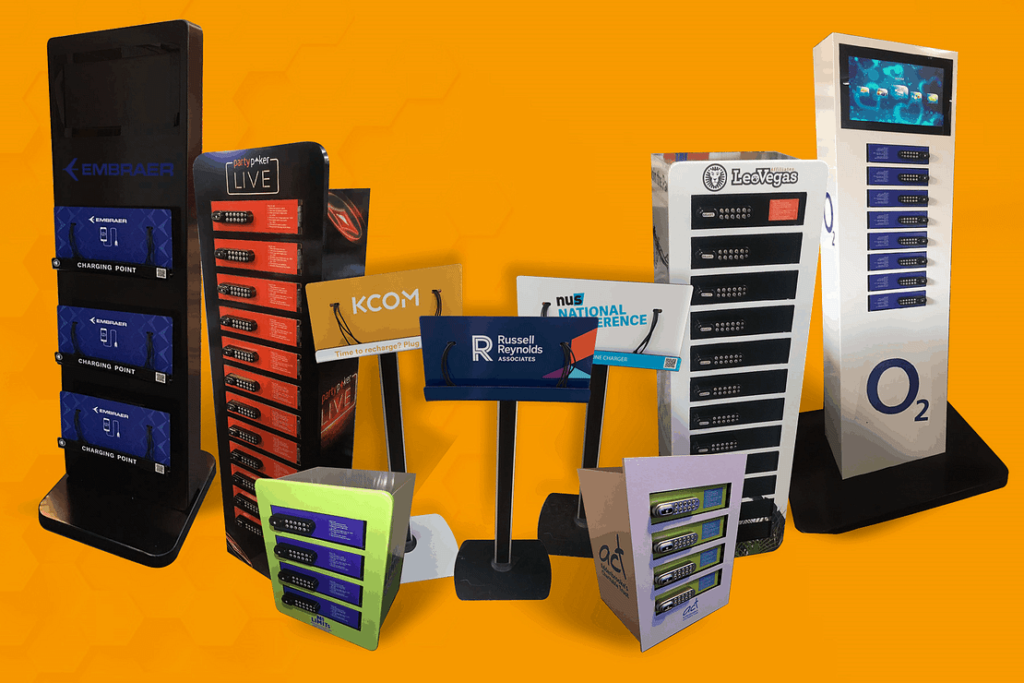
Chargezone festivals Phone Charging station
Festival Phone Charging Stations & Phone Charging Lockers: The Complete UK Guide
1. Introduction
There’s a very specific kind of panic that only exists at festivals. It’s not the queue for the toilets, and it’s not realising you’ve left your wellies in the tent when the heavens open. It’s watching your battery percentage tick down from 12% to 8% to 4%, knowing you’ve still got two headline sets, a lost friend to find, and a taxi to book before the night’s out.
Ten years ago, a dead phone at a festival was mildly annoying. Today, it’s a genuine problem. Your ticket lives in an app. Your bar tab is a wristband linked to a phone-based top-up system. Your festival map, set times, and toilet locations are all in an app too. If you’ve arranged to meet friends “by the big tree at 6pm” and your phone dies at 5pm, you’re not meeting anyone.
This guide is written for the people who have to solve that problem: festival organisers, event managers, university events teams, local authorities running outdoor shows, and the sponsors who want to be part of the solution rather than just another logo on a lanyard. We supply and support phone charging infrastructure for events across the UK, and this guide draws on what we’ve learned doing exactly that — what works, what visitors actually want, what trips organisers up, and how to turn a simple charging point into something that pays for itself.
Over the next 20,000-odd words, we’ll cover why charging has become essential festival infrastructure, the different types of charging stations and lockers available, how sponsorship activations work in practice, what to look for in a supplier, and the questions you should be asking before you sign anything. We’ve also included 60 detailed FAQs, comparison tables, checklists, and — because we’d rather be upfront about it than bury it — details of a summer offer for organisers currently planning their charging infrastructure.
Why phone charging stations has become essential at UK festivals
A few things have converged to make this a genuine piece of event infrastructure rather than a nice-to-have:
Battery anxiety is real and measurable. Festival-goers now treat their phone battery the way they used to treat their wallet — something to protect and top up before it runs low, not after. The fear of being stranded without a working phone, unable to find friends or call for help, is now a well-documented driver of visitor behaviour at events.
Cashless festivals mean a dead phone can mean no way to pay. Many UK festivals now run on RFID wristbands linked to phone apps for top-ups, or on phone-based contactless payment as a backup. If your phone’s dead, topping up your wristband or paying for a bottle of water becomes far harder.
Digital tickets are the default. Paper tickets are increasingly rare. Most festivals issue tickets via app or PDF-to-wallet, scanned at the gate. A dead phone at the entrance is a queue-stopping problem, both for the visitor and for everyone behind them.
Festival apps are doing more heavy lifting than ever. Set times, interactive maps, food vendor menus, safety information, lost property reporting, and accessibility services increasingly all live inside the official festival app.
Emergency contact matters more at a festival than almost anywhere else. Large crowds, patchy phone signal, and unfamiliar surroundings mean that being able to reach a friend, welfare team, or emergency services is genuinely important — not just convenient.
Social media is part of the festival experience itself. Whether organisers like it or not, visitors document festivals in real time. A flat phone doesn’t just stop someone posting a story; it removes a meaningful part of how many people experience and remember the day.
Navigation and site-finding rely on a working phone. Large festival sites, often on farmland or in parkland with few fixed landmarks, mean many visitors lean on maps or location-sharing to find friends, stages, and campsites.
Safety and welfare provision increasingly assumes visitors have a working phone. Welfare teams, medical points, and site safety messaging often direct people to text a number, use an app, or call a helpline.
Put simply: a phone charging station isn’t a side amenity any more. It’s closer to toilets, water points, and first aid — infrastructure that keeps an event running smoothly and keeps people safe.
2. Why Festivals Need Phone Charging Stations
It’s worth pausing on the evidence before getting into the practicalities, because organisers weighing up budget for charging infrastructure are usually weighing it against something else — more toilets, a bigger stage, better signage. Understanding the scale of the need helps make that case.
Visitor behaviour and battery usage
Modern smartphones are used far more intensively at festivals than in everyday life. Across a typical festival day, a visitor’s phone is likely to be:
- Used as a ticket and wristband top-up device on entry
- Photographed and filmed repeatedly throughout the day
- Used for messaging and calls to coordinate with friends across a large site
- Running a festival app in the background, often with location services on
- Used for mobile payments at bars and food stalls
- Streaming or browsing during downtime
- Used as a torch late at night, particularly at campsites
Each of these draws down battery faster than normal use, and many festival sites have weaker mobile signal than visitors are used to at home, which means phones work harder to maintain a connection — another significant drain. A phone that comfortably lasts a full day in normal use can be flat by mid-afternoon at a busy festival.
Festival technology has raised the stakes
The move to cashless payment systems, app-based ticketing, and digital wristband top-ups means a dead phone is no longer just an inconvenience — it can stop someone spending money, entering a site, or accessing services they’ve already paid for. Organisers who’ve invested in slick, modern cashless and app infrastructure have, in effect, also taken on a responsibility to make sure people can keep their phones charged enough to use it.
Security and lost property
Festival welfare and security teams consistently report that a meaningful proportion of lost property and welfare incidents involve someone who can’t be contacted because their phone is dead, or who has become separated from their group with no way to reconnect. Charging infrastructure — particularly secure lockers — reduces this friction directly.
Accessibility
For disabled visitors, older attendees, and anyone managing a health condition, a working phone can be essential rather than optional — for medical alerts, communicating access needs to staff, or simply feeling confident enough to attend at all. Charging provision is increasingly considered as part of an event’s wider accessibility offer, alongside accessible viewing platforms and quiet spaces.
Cashless payments and emergency services
Where a festival’s payment system depends on a phone (whether for RFID top-ups managed via app, or direct contactless mobile payment), the charging point becomes financial infrastructure as much as convenience. And in a genuine emergency, the difference between a working and a dead phone can be the difference between reaching help quickly and not reaching it at all.
A quick snapshot: what organisers tell us
Speaking with event organisers year after year, a few consistent themes come up:
- Phone charging is now one of the top three most-searched terms on festival apps and websites in the run-up to an event, alongside “toilets” and “what can I bring.”
- Complaints about a lack of charging facilities are among the most common pieces of post-event feedback at festivals that don’t provide it.
- Festivals that do provide clearly signposted charging report noticeably fewer welfare call-outs related to lost or separated visitors.
None of this means every festival needs a charging solution the size of a small power station. It means charging has moved from “nice extra” to “expected infrastructure,” in the same category as clean water points and clear signage — and budgeting for it should reflect that.

16 cable pin mobile phone charging station
3. What is a Festival Phone Charging Station?
“Phone charging station” gets used as a catch-all term, but in practice there’s a fair amount of variety in what’s actually on offer at UK festivals. Understanding the differences matters because they solve different problems, come with different costs, and carry different levels of security.
Locker charging
A bank of individually lockable compartments, each with a charging cable inside. The visitor puts their phone in, sets a PIN or taps a wristband, and the door locks. They can then walk away — to watch a set, queue for food, or find friends — and come back later to a charged phone that’s been safely locked away the whole time. This is the gold standard for festivals because it solves both charging and security in one unit.
Open charging
A simpler setup: a table, bar, or wall-mounted unit with charging cables hanging off it, and no locking mechanism. The visitor plugs in and either waits nearby or leaves the phone unattended (which most festivals actively discourage, for obvious reasons). Cheaper and easier to deploy, but it puts the onus on the visitor to keep an eye on their device, and theft risk is far higher in a crowded festival environment.
Fast charging
Modern charging stations, whether locker-based or open, increasingly support fast-charging standards (such as USB Power Delivery), which can take a phone from empty to a usable level of charge in a fraction of the time older 5W chargers would need. This matters a lot in a festival context, where visitors often want their phone back within 30–60 minutes rather than leaving it for hours.
USB-C, Lightning, and connector variety
The connector landscape has shifted significantly, with USB-C now standard across most Android devices and, following recent EU-driven changes, increasingly standard on newer Apple devices too — though plenty of visitors will still turn up with older Lightning-cable iPhones for some years yet. A well-specified charging station should offer multiple cable types (USB-C, Lightning, and Micro-USB) at every point, not just one.
Wireless charging
Some newer charging units include Qi wireless charging pads as well as cabled options. These are handy but slower than cabled fast charging and require the visitor to leave their phone sitting on the pad rather than stashed securely — better suited to festival VIP areas, hospitality suites, or sponsor lounges than high-footfall public zones.
Power banks
Rechargeable portable battery packs, either handed out by sponsors as a giveaway, or offered on a rental/deposit basis via vending-style kiosks. These give visitors mobility — they can keep the power bank in their pocket and stay charging on the move — but they run out themselves, need to be returned or recharged, and are one of the most commonly lost or “accidentally kept” pieces of festival kit going.
Solar charging
Solar-powered charging units — often combined with a battery buffer so charging continues after dark — are popular at environmentally-conscious festivals and in more remote locations without easy access to mains power or generators. They’re a great sustainability talking point, though output can be inconsistent on cloudy British summer days, so they usually work best as a supplement to grid or generator-powered stations rather than a sole charging solution for a large event.
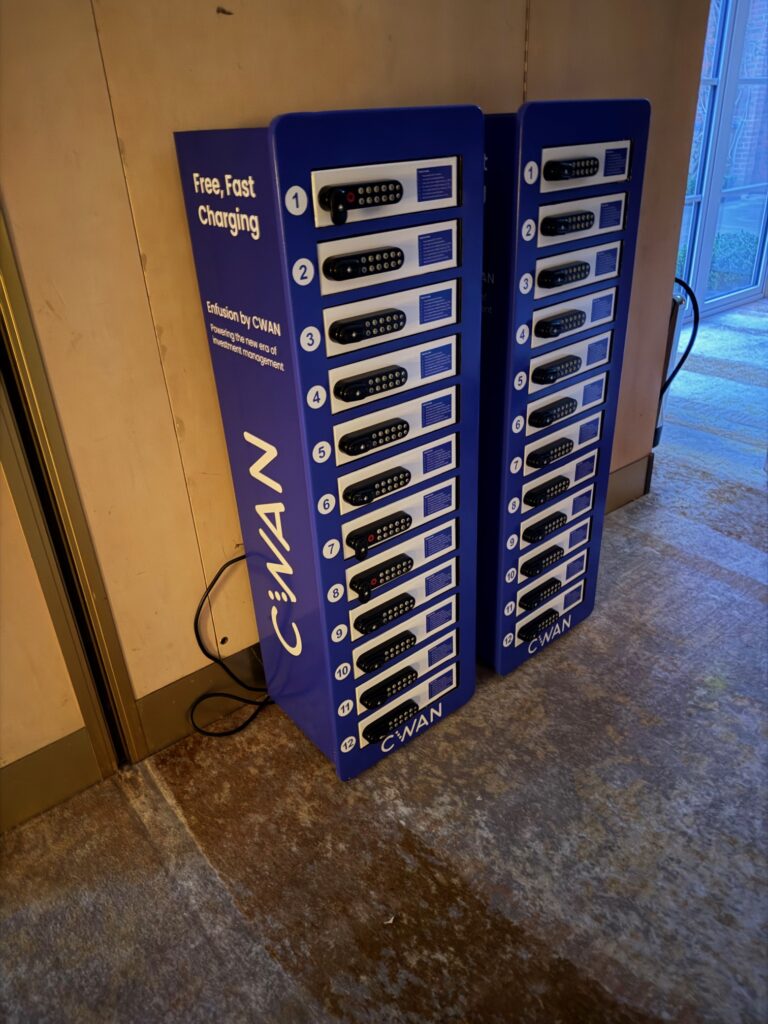
Phone charging Locker with digital pin code
Sponsored and branded Phone charging stations
Any of the above can be wrapped in sponsor branding — the unit itself, the screen (if it has one), the surrounding signage, and sometimes the charging cables. This is where charging infrastructure crosses over from pure utility into a genuine marketing asset, which we cover in detail in Section 6 and Section 7.
Comparison at a glance
| Type | Security | Speed | Best for | Typical cost profile |
|---|---|---|---|---|
| Locker charging | High | Fast (with modern units) | Main charging hubs, high-footfall areas | Mid–high |
| Open charging | Low | Fast–moderate | Small events, VIP/backstage, low-risk areas | Low |
| Power banks | Depends on scheme | Moderate | On-the-go visitors, giveaways, sponsor activations | Low–mid |
| Solar charging | Varies by unit | Slower, weather-dependent | Sustainability-focused or off-grid sites | Mid |
| Wireless pads | Low (unattended) | Slower | Hospitality, VIP lounges | Low–mid |
For most mid-to-large UK festivals, the practical answer is a mix: secure lockers as the backbone of the public charging offer, supplemented by sponsor-branded power bank giveaways or open charging in lower-risk areas like backstage or VIP.
4. Festival Phone Charging Lockers
Because lockers are the backbone of most serious festival charging deployments, they’re worth a section of their own.
How the locking systems work
PIN code lockers. The visitor chooses or is issued a numeric code when they place their phone inside. They re-enter the same code to unlock the door later. Simple, low-tech, and reliable — the main risk is a visitor forgetting their code, which a good operator handles with a manual staff override and ID verification process.
RFID and wristband access. Increasingly common at festivals that already issue RFID wristbands for entry and cashless payment. The visitor taps their wristband to lock and unlock the same compartment, which is fast, doesn’t require remembering a code, and ties neatly into infrastructure the festival already has in place.
Digital access and app-based systems. Some newer units allow booking, locking, and unlocking via a dedicated app or QR code, sometimes with SMS confirmation. These can support features like locker availability shown in real time, pre-booking, and remote monitoring.
Key-based lockers. Simple physical key locks, less common at large-scale festivals now (keys get lost, and there’s no remote monitoring), but still seen at smaller community events and shows.
Security monitoring
A properly run locker bank isn’t just a locked box — it’s a staffed and monitored piece of infrastructure. Look for:
- On-site staff during operating hours to help with lost codes, technical issues, and general queries
- CCTV coverage of the locker bank itself
- Tamper alerts or monitoring on the unit (many modern systems can flag attempted forced entry)
- A clear process for what happens to a phone that isn’t collected by the end of the day or event
Capacity
Locker banks are typically supplied in standard configurations — commonly 12-locker units, which can be deployed singly or grouped together into larger banks of 24, 36, 48 or more compartments depending on expected footfall. Section 9 covers how to calculate the right number for your event size.
Weather resistance
UK festivals mean UK weather, which means rain, wind, mud, and the occasional heatwave, sometimes all in the same weekend. Charging lockers need to be genuinely weatherproof — sealed housings, appropriate IP ratings on electrical components, and secure fixings so units can’t be blown over or flooded. This isn’t a “nice to have” spec; it’s a basic safety requirement when you’re combining mains electricity with an outdoor environment.
Accessibility
Locker banks should be positioned and specified with accessibility in mind: a step-free approach, lockers at a reachable height for wheelchair users, and clear, high-contrast signage. Where budget allows, having at least one bank near an accessible campsite or viewing platform, rather than only in the main high-footfall areas, makes a genuine difference to disabled visitors.
The core benefit: charging and security in one
The reason lockers have become the standard for serious festival deployments, rather than open charging tables, comes down to one thing: they solve two problems at once. The visitor gets their phone charged, and they get it looked after while they’re off enjoying the festival. That combination is what turns “somewhere to charge my phone” into “somewhere I trust to leave my phone.”
5. Benefits for Festival Organisers
If you’re the one signing off the budget, the case for charging infrastructure isn’t just “visitors like it.” It has a measurable effect on the things organisers are actually judged on.
Increased visitor satisfaction
Post-event survey data across the UK festival sector consistently shows that “having somewhere to charge my phone” ranks among the amenities visitors most notice — and most complain about the absence of. Providing it well is one of the more cost-effective ways to lift overall satisfaction scores, because it’s a specific, memorable, easily-articulated need that either gets met or doesn’t.
Increased dwell time and spend
A visitor waiting for their phone to charge, or knowing it’s safely locked away charging, tends to stay in that area of the site rather than leaving. Positioned near food courts, bars, or sponsor villages, charging points can genuinely increase footfall and dwell time in commercially important zones — which matters to organisers managing concession revenue as much as it does to the sponsors themselves.
Improved safety
Fewer flat phones means fewer separated groups, fewer welfare call-outs for “can’t find my friends,” and a faster route to help in a genuine emergency. Charging infrastructure is a quiet but real contributor to overall event safety.
Sponsorship revenue
Charging stations are one of the more attractive sponsorship assets available at a festival, because they combine guaranteed dwell time (people are physically there for several minutes to tens of minutes), high visibility, and a positive association (the brand is helping, not just advertising). We go into this in depth in Sections 6 and 7, but for organisers, this is real, incremental revenue that can offset — or in some cases fully cover — the cost of the infrastructure itself.
Reduced lost property
Lockable charging removes one of the more common causes of lost and stolen phones at festivals: visitors leaving devices charging unattended on open tables or handing them to a stranger to “keep an eye on.” Fewer lost phones means less strain on lost property teams and fewer distressed visitors.
Improved event reputation
Word of mouth and social proof matter enormously in the festival sector. Visitors talk about the practical things that made their day easier as much as they talk about the headline act. “They had proper phone charging lockers, it was so easy” is the kind of comment that shows up in reviews, festival forums, and social media — and it contributes to a festival’s reputation for being well-run.
Premium experience creation
For festivals with VIP or hospitality tiers, branded charging facilities (nicer units, faster charging, a dedicated attendant) are an easy way to add a tangible point of difference to a premium ticket, at relatively low cost compared to other hospitality upgrades.
Summary table: organiser benefits
| Benefit | How it shows up |
|---|---|
| Visitor satisfaction | Higher post-event survey scores, fewer complaints |
| Dwell time & spend | More time and money spent in charging-adjacent zones |
| Safety | Fewer welfare call-outs, faster contact in emergencies |
| Revenue | Sponsorship income, potential to offset infrastructure cost |
| Lost property | Fewer stolen/lost phones, less admin burden |
| Reputation | Positive word of mouth, stronger reviews |
| Premium tiers | Point of difference for VIP/hospitality packages |
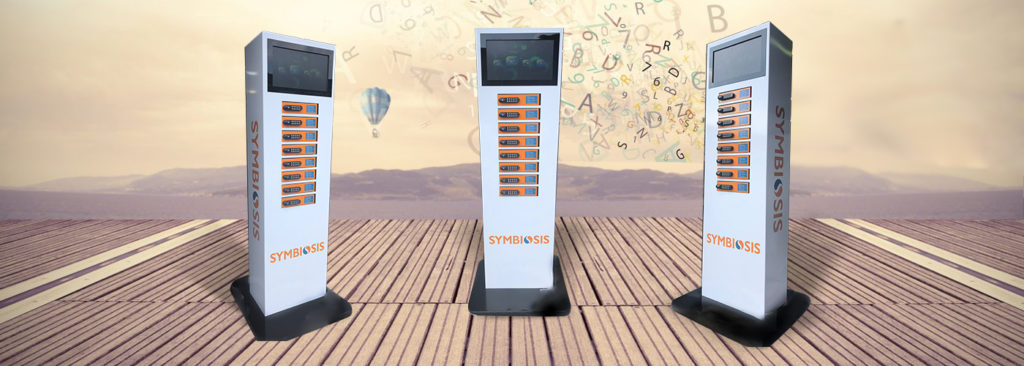
Mobile phone charging lockers with lcd screen
6. Benefits for Sponsors
If organisers are asking “what does this do for my event”, sponsors are asking a different question: “what does this do for my brand.” The honest answer is: quite a lot, if it’s set up properly.
Brand awareness through guaranteed dwell time
Most sponsorship assets at a festival — a stage banner, a programme ad, a tent in a sponsor village — rely on visitors glancing at them in passing. A charging locker is different: the visitor is physically present, often for anywhere from ten minutes to well over an hour, standing or sitting right next to the branding while they wait, browse their phone, or chat with friends. That’s sustained, low-distraction attention that’s genuinely hard to buy elsewhere on a festival site.
Sampling and product trial
Charging zones are a natural spot for sampling activity — a drinks brand handing out chilled cans while people wait, a skincare brand offering sun cream on a hot day, a snack brand giving out samples. The captive, relaxed audience (people aren’t rushing off mid-set) makes for a far better sampling environment than a stall people walk past.
Lead generation and data capture
Many charging locker systems can be integrated with a simple sign-up step — an email address or app download in exchange for a locker code, for instance — giving sponsors a genuine, opted-in lead generation mechanism rather than a QR code nobody scans. Handled properly and transparently (with clear consent and GDPR compliance), this is one of the more effective data capture opportunities available at a festival.
App downloads and digital engagement
Telecoms brands, festival apps, banking apps, and gaming companies in particular have used charging stations as a natural moment to prompt an app download — “download our app while your phone charges” is a genuinely logical, non-intrusive ask, unlike trying to get someone to download something mid-conversation at a bar.
Social media engagement
Branded, photogenic charging installations — especially ones with a fun design, a photo backdrop, or an interactive element — regularly get organically shared by visitors on social media, extending brand reach well beyond the festival site itself and the people physically present.
Competition mechanics
“Tap your wristband, enter our prize draw while you charge” is a simple, low-friction competition mechanic that works well in a charging context because the visitor is already stationary and has a few spare minutes.
QR codes and quick activations
QR codes on locker screens or surrounding signage can drive visitors to a landing page, a voucher, a survey, or a social channel — again benefiting from a captive audience with time on their hands.
Product launches and brand activations
Charging stations have been used as a stage for product launches in their own right — new phone models, new accessories, new drinks products — combining the practical charging function with a branded showcase area where the sponsor’s product is genuinely the star.
Illustrative examples of what’s worked well
- A telecoms brand branding a full charging village with staff on hand to answer questions about upgrading tariffs, using the natural dwell time to have real conversations rather than a rushed pitch.
- A soft drinks brand sponsoring charging lockers positioned directly outside a main stage, sampling chilled product to a warm, thirsty, and receptive queue.
- A student-focused bank or insurance brand sponsoring charging at university-affiliated festivals, using sign-up-for-a-locker-code as a genuine, consented lead capture mechanic.
- An energy drink brand wrapping a bank of lockers in eye-catching branding positioned near the campsite entrance, catching visitors both on arrival and on their way to bed after a big night.
Why brands increasingly prefer this over generic banner sponsorship
Generic signage is passive — a logo people glance past. Charging sponsorship is active: it solves a real, immediate problem for the visitor, which means the brand gets associated with genuinely helping rather than simply advertising. That distinction matters more with festival audiences, who tend to be sceptical of overt marketing but receptive to brands that add real value to the day.
7. Festival Charging Sponsorship Ideas
There’s more than one way to structure a charging sponsorship, and the right approach depends on the sponsor’s goals, budget, and the size of the event. Here are more than 20 ideas organisers and sponsors can consider, ranging from full-scale title sponsorship to smaller, targeted activations.
- Title/headline sponsorship — “Charging Village powered by [Brand],” with full-site branding across every locker location.
- Single-zone headline sponsor — one flagship, heavily-branded charging hub near the main stage, with smaller unbranded or lightly-branded units elsewhere.
- Tech/telecoms sponsor — a mobile network or device brand sponsoring charging as a natural extension of their product category.
- Energy/utility sponsor — an energy company using charging sponsorship to tie into sustainability and power messaging (particularly effective alongside solar units).
- University/education sponsor — a university or student finance provider sponsoring charging at events with a strong student demographic.
- Telecoms network sponsor — offering charging alongside SIM deals, network upgrade offers, or signal-boosting information.
- Gaming sponsor — a games publisher or console brand running competitions or demos at the charging point.
- Drinks sponsor — soft drink, energy drink, or (where licensing allows) alcohol brands sampling product at charging zones.
- Insurance sponsor — gadget or travel insurance brands using the “keep your phone safe” message as a natural tie-in.
- Banking/fintech sponsor — particularly effective at cashless festivals, tying charging to app downloads or card sign-ups.
- Streaming service sponsor — offering free trial sign-ups while visitors wait for their phone to charge.
- Skincare/suncare sponsor — sampling sun cream or after-sun at daytime charging points, positioned as care for the visitor.
- Local council/tourism sponsor — for county shows and civic events, promoting local attractions or services.
- Charity partner activation — a charging point that also raises awareness or micro-donations for a partner charity.
- Festival app sponsor — the festival’s own official app provider co-branding charging points to boost app downloads.
- Transport/rideshare sponsor — promoting safe travel home, particularly effective at campsite-adjacent charging locations late at night.
- Food delivery or vendor sponsor — cross-promoting on-site food stalls or delivery services.
- Sustainability/eco sponsor — pairing solar charging units with an environmental brand or campaign.
- Radio station or media partner sponsor — using charging zones for interviews, giveaways, or live content capture.
- Fashion/merch brand sponsor — sampling or discounting festival merchandise at the charging point.
- Multi-brand co-sponsorship — splitting costs and branding across two or three complementary (non-competing) sponsors for larger installations.
- VIP/hospitality charging sponsor — a premium brand (e.g. a spirits or luxury goods brand) sponsoring a smaller, higher-spec charging lounge in VIP areas.
- Campsite charging sponsor — sponsoring charging points specifically at campsite entrances or communal camping areas, a high-value overnight touchpoint.
What makes a charging sponsorship package attractive to sell
- Clear, quantifiable dwell time and footfall data from previous events (or realistic projections for first-time deployments)
- Flexible branding options, from full unit wraps to smaller signage packages at different price points
- A menu of add-on activations (sampling, competitions, data capture) that sponsors can pick and choose from
- Photography and social content rights so sponsors can use images of their branded activation in their own marketing afterwards
- A simple, honest post-event report showing usage numbers, engagement, and (where applicable) leads captured
8. How Charging Lockers Work
For organisers who haven’t deployed this kind of infrastructure before, it helps to walk through the practical, day-to-day mechanics.
Booking
Larger festivals typically arrange charging infrastructure as part of their overall site services planning, alongside toilets, water, and power — usually booked months in advance to secure availability, particularly across a busy UK festival season (roughly May to September, with a secondary bump around Christmas markets and winter events). Smaller and one-off events can often book more flexibly, sometimes with only a few weeks’ notice, depending on supplier availability.
Charging
Once on site, the process for the visitor is straightforward:
- Approach the locker bank and select an available compartment.
- Plug their phone into the appropriate cable (USB-C, Lightning, or Micro-USB).
- Close the door and set a PIN, or tap their RFID wristband, to lock it.
- Walk away and enjoy the festival while their phone charges safely.
- Return, unlock with their PIN or wristband tap, and collect their charged phone.
Collection and unattended devices
A good operator has a clear, published policy for what happens if a phone isn’t collected — usually held securely until a set time (often end of day or end of the event), with a manual staff-assisted unlock process backed by ID verification, to prevent one visitor claiming another’s device.
Security throughout
Beyond the lock itself, well-run charging locker deployments include staff presence during peak hours, visible CCTV, and tamper-evident housings. Some operators also offer real-time remote monitoring, so any fault or attempted interference is flagged immediately rather than discovered hours later.
Monitoring and maintenance
Professional suppliers monitor charging units throughout an event — checking power supply, unit temperature (particularly relevant in a hot summer or packed crowd), and locker fault rates — and carry spare parts or backup units to swap out anything that fails. This kind of proactive maintenance is one of the clearest differences between a reliable supplier and a budget one.
Staff support
Even the most intuitive system benefits from a friendly face nearby, especially during a festival’s busiest hours. Staff help with forgotten PINs, jammed doors, cable compatibility questions, and general reassurance — which matters more than it might sound, because visitors are trusting a stranger’s equipment with an expensive, essential device.

Mobile phone charging station (Non-Locker)
9. Features to Look For
Not all charging stations and lockers are built to the same standard. Here’s what separates a genuinely good specification from one that will cause headaches on-site.
Fast charging
Look for units that support modern fast-charging standards rather than basic 5W output. The difference between a phone reaching a usable charge in 30 minutes versus 90 minutes matters enormously to a visitor who doesn’t want to miss a set.
Multiple connectors at every point
Every locker or charging point should offer USB-C, Lightning, and Micro-USB as standard, so visitors aren’t left hunting for the one compartment with the right cable.
Digital screens
Screens on or near locker banks can display branding, wayfinding information, festival announcements, or safety messages — useful for organisers and valuable real estate for sponsors.
Branding flexibility
Good units are designed to be easily wrapped or fitted with branded panels, without needing bespoke manufacturing for every event — this keeps sponsorship activations achievable on realistic timelines and budgets.
Lighting
Built-in lighting matters for evening and night-time use — both so visitors can see what they’re doing, and so the units remain visible, welcoming, and easy to find after dark, rather than becoming a dark corner of the site.
Remote monitoring
The ability for a supplier to check unit status, power draw, and fault alerts remotely — without needing a staff member physically checking every unit constantly — makes for faster fault resolution across a large or multi-location site.
Weatherproofing
As covered in Section 4, genuine weatherproofing (sealed housings, appropriate IP ratings, secure outdoor fixings) isn’t optional for UK events.
PAT testing
All electrical equipment deployed at a UK event should be PAT tested (Portable Appliance Tested) with current, valid certification, and a supplier should be able to produce this without being asked twice.
Insurance
Public liability insurance, and ideally equipment/goods-in-transit insurance, should be confirmed before any contract is signed. We cover the specifics organisers should ask for in Section 10.
Quick-reference features checklist
- Fast charging (Power Delivery / Quick Charge compatible)
- USB-C, Lightning, and Micro-USB cables at every point
- Secure locking (PIN, RFID, or app-based)
- Weatherproof housing with appropriate IP rating
- Built-in lighting for after-dark visibility and use
- Branding-ready panels or wraps
- Remote monitoring capability
- Valid, current PAT testing certification
- Confirmed public liability insurance
- On-site staff support during operating hours
- Clear unattended-device / end-of-day collection policy
- Accessible positioning and step-free access
10. Choosing the Right Supplier
The charging infrastructure market has grown quickly, and quality varies a lot. Asking the right questions before you commit will save you a difficult conversation mid-festival.
Questions organisers should ask
Insurance and compliance
- Can you provide current public liability insurance documentation?
- Is all equipment PAT tested, and can you provide certificates on request?
- Do you carry goods-in-transit and equipment insurance?
Support and staffing
- Will there be staff on site during the event, and for what hours?
- What’s your response time if a unit develops a fault mid-event?
- Do you provide a dedicated contact for the event, not just a general helpline?
Delivery and setup
- Do you handle delivery, installation, and collection, or is that the organiser’s responsibility?
- How much lead time do you need on site for setup and testing before doors open?
- What power supply do you need us to provide (mains connection, generator spec, or is the unit self-contained)?
Breakdown and contingency
- What’s your policy if a unit fails completely during the event — do you carry spares?
- Is there a written contingency plan for adverse weather (high winds, flooding)?
Nationwide coverage
- Can you deliver and support events across the whole of the UK, or only within a limited region?
- Have you supplied events of a similar scale and setting to ours before?
Risk assessments and method statements
- Can you provide a full risk assessment and method statement (RAMS) in advance for our event safety documentation?
- Will your team attend a site visit or production meeting if required?
Certification
- Can you confirm PAT certificates are dated within the last 12 months?
- Is your electrical installation work signed off by a qualified, insured electrician?
Red flags to watch for
- Reluctance or delay in providing insurance or PAT documentation
- No named contact for the event, only a generic email address
- Vague answers about what happens if a unit breaks down
- No prior experience with outdoor events specifically (indoor-only equipment isn’t always built for festival conditions)
- Pricing that seems significantly below the market without a clear explanation why
A simple supplier comparison framework
| Criteria | Weak supplier | Strong supplier |
|---|---|---|
| Insurance | Can’t produce documents quickly | Insurance and PAT certs shared proactively |
| Staffing | Drop-off only, no on-site support | Trained staff present during peak hours |
| Equipment | Generic, indoor-style units | Purpose-built, weatherproof, festival-tested |
| Contingency | No clear fault process | Spares held on site, documented escalation process |
| Experience | No festival references | Established festival and outdoor event portfolio |
| Communication | Slow, generic responses | Named contact, responsive throughout planning |
Taking the time to ask these questions up front — even if it feels like unnecessary due diligence for what seems like a simple hire — is what separates a smooth deployment from a stressful one.
11. Festival Types
Charging infrastructure isn’t one-size-fits-all. The right setup varies significantly depending on the type of event.
Music festivals. The heaviest use case — large crowds, multi-day attendance, camping, high phone usage for social media and coordinating groups across a big site. Usually needs multiple locker banks across different zones (main arena, campsite, VIP).
Food festivals. Shorter visitor dwell times but high footfall, often in town centre or park settings. Compact charging units near seating or main thoroughfares work well.
Beer and drinks festivals. Similar profile to food festivals, often indoor or in marquees, with a slightly older average visitor age — worth factoring into signage clarity and unit positioning.
Pride events. High footfall, strong emphasis on safety and welfare provision, often with charging positioned near welfare and information points as much as entertainment areas.
University festivals and freshers’ events. Young, highly phone-dependent audience, strong appetite for sponsor activations (particularly finance, telecoms, and food delivery brands), and often held on campus with easier access to mains power.
Sporting events. Charging is often positioned near hospitality and spectator zones, with an audience that may be there for many hours and wants a phone ready for photos, results-checking, and travel arrangements home.
Christmas festivals and markets. Shorter visitor windows but cold weather significantly drains battery life faster, making charging provision genuinely appreciated; units need appropriate cold-weather specification.
County shows and agricultural shows. Often rural sites with limited existing power infrastructure, making self-contained or solar-supplemented units particularly useful; audience skews family and multi-generational.
Outdoor cinema events. Long, static dwell times make charging especially valuable — visitors are seated for hours and appreciate topping up during the film.
Motor festivals and shows. Enthusiast audiences who photograph and film extensively; charging near main display areas gets heavy use.
Air shows. Very high single-day footfall, often in open fields with minimal existing infrastructure; charging combined with shade and seating is a popular pairing.
Corporate festivals and staff events. Smaller scale but higher expectations around branding, presentation, and premium feel — a good fit for higher-spec, more heavily branded units.
Choosing charging provision by festival type
| Festival type | Priority | Recommended setup |
|---|---|---|
| Music festival (multi-day) | Volume + security | Multiple locker banks, staffed, campsite + arena coverage |
| Food/drink festival | Footfall + speed | Compact fast-charging units near seating |
| University event | Sponsor engagement | Branded lockers with app/data-capture tie-ins |
| County/agricultural show | Self-sufficiency | Solar-supplemented or generator-powered units |
| Christmas market | Cold-weather reliability | Weatherproof, well-lit units near main thoroughfare |
| Corporate event | Presentation | Higher-spec, heavily branded, smaller footprint |
12. How Sponsors Benefit (ROI in Detail)
Section 6 covered the qualitative benefits for sponsors; it’s worth digging into how those translate into measurable return on investment, because that’s usually the conversation a sponsor’s marketing team needs to have internally before signing off budget.
Brand impressions
Unlike a static banner, a charging locker generates impressions over an extended, repeated dwell time — often several minutes per visitor, sometimes much longer — rather than a fleeting glance. Multiply that by hundreds or thousands of uses across a festival weekend, and the cumulative exposure is substantial.
Social engagement
Well-designed, photogenic charging installations get shared. A branded backdrop, a fun interactive element, or simply a genuinely useful service worth mentioning in a story or post extends reach beyond the physical audience on site.
Footfall and dwell time
Because visitors are drawn to charging points specifically (rather than passing by incidentally), footfall is self-selecting and dwell time is naturally longer than most other sponsorship placements — both valuable metrics sponsors can report back on internally.
Lead generation
Where a sign-up mechanic is built into the locker access process, sponsors get a genuinely opted-in, consented database of engaged festival-goers — a far higher-quality lead source than a generic email capture form at a stall people rarely stop at.
Case study framing sponsors can use internally
When pitching a charging sponsorship internally, marketing teams typically build the case around:
- Estimated total dwell-time impressions across the event (based on locker usage numbers and average dwell time)
- Number of data-capture opt-ins or app downloads generated
- Social media reach from user-generated content and official festival channels
- Qualitative brand association (“helpful,” “practical,” “cares about visitor experience”) versus purely promotional placements
A simple ROI framing table
| Metric | What it demonstrates |
|---|---|
| Total locker uses | Raw reach/impressions |
| Average dwell time per use | Depth of exposure per impression |
| Opt-ins / sign-ups | Lead generation quality |
| Social shares / UGC | Extended reach beyond the site |
| Post-event survey brand recall | Brand association and memorability |
Sponsors and organisers should agree reporting metrics before the event, not after, so the data that matters is actually captured on the day.
13. Phone Charging Lockers vs Power Banks
Both have a place at festivals, but they solve slightly different problems, and it’s worth being clear-eyed about the trade-offs.
| Factor | Charging Lockers | Power Banks |
|---|---|---|
| Security | High — phone is locked away, out of sight | Low–moderate — device stays with visitor but power bank itself can be lost |
| Mobility | None — visitor must return to the locker | High — visitor keeps charging on the move |
| Speed | Fast (with modern fast-charging units) | Depends on power bank capacity and phone draw |
| Upfront cost to organiser | Moderate–higher (hire of fixed infrastructure) | Lower per unit, but ongoing replacement/loss costs |
| Visitor experience | “Charge and forget,” return later | Convenient but another item to carry and remember |
| Environmental impact | Lower — reusable, durable infrastructure | Higher — power banks are frequently lost, discarded, or not returned |
| Sponsorship value | High — fixed, brandable, high-dwell-time asset | Good for giveaways and brand recall, lower dwell time |
| Best suited to | Main charging hubs, high-footfall zones | On-the-go visitors, smaller events, giveaway activations |
Costs
Charging lockers are typically hired as complete units for the duration of an event, with pricing reflecting delivery, setup, staffing, and collection. Power banks are usually either purchased in bulk for giveaway/sponsorship purposes (with an accepted loss/non-return rate factored in) or offered through a vending-style rental scheme with a deposit system.
Environmental impact
From a sustainability perspective, lockers generally come out ahead: they’re durable, reusable infrastructure that gets redeployed event after event. Power banks, particularly giveaway ones, have a much higher rate of loss, damage, or disposal — meaningful for organisers and sponsors increasingly judged on the environmental footprint of their activations.
The practical answer
Most well-run larger festivals use both: secure lockers as the primary charging solution, and power banks as a lighter-touch, mobile option — often as a sponsor giveaway or a paid/deposit rental for visitors who specifically don’t want to leave their phone behind.
14. Why Secure Charging Matters
It’s worth stating plainly: an unlocked charging cable hanging off a table in a crowd of thousands of people is a theft risk, and festivals have learned this the hard way over the years.
Theft prevention
Open, unattended charging setups are a known target for opportunistic theft — a phone left plugged in while its owner nips to the toilet or gets distracted by a friend is an easy target in a crowded environment. Lockers remove this risk almost entirely by keeping the device out of sight and physically secured.
Device protection
Beyond theft, secured charging also protects devices from accidental damage — knocked off tables, trodden on, or rained on — all realistic risks in a busy outdoor festival environment.
Visitor confidence
Visitors are noticeably more willing to use charging facilities, and to leave their phone for longer, when they trust the security of the system. This directly affects usage rates and, in turn, sponsor exposure and visitor satisfaction.
Insurance implications
For organisers, secure, professionally installed and monitored charging infrastructure is also easier to justify from an insurance and duty-of-care perspective than an ad hoc, unsecured setup — worth noting when preparing event risk assessments.
15. Festival Technology Trends
Charging infrastructure doesn’t exist in isolation — it sits within a broader shift in how UK festivals use technology, and it’s worth organisers keeping an eye on where things are heading.
AI and smart festivals
Festival apps are increasingly using AI-driven features — personalised set-time recommendations, crowd density alerts, and chatbot-style customer service — all of which increase reliance on visitors having a charged, connected phone throughout the day.
Cashless payments
Cashless wristband and app-based payment systems continue to expand across the UK festival circuit, replacing cash bars and card machines with tap-to-pay wristbands topped up via phone. This trend directly increases the importance of charging provision, since a dead phone can mean an inability to top up or check a balance.
Event apps
Beyond ticketing, festival apps now commonly handle set-time clashfinders, interactive maps, accessibility requests, lost property reporting, and safety messaging — concentrating more essential functions into a single device that needs to stay powered.
Wearables
Some festivals have experimented with wearable tech — smart wristbands with built-in payment or access functions — which can reduce reliance on phones for some tasks, but rarely eliminates the need for a charged phone entirely, since most wearables are still paired to and managed via a phone app.
Sustainability
Environmental impact is a growing consideration across every part of festival operations, and charging infrastructure is no exception. Expect continued growth in solar-supplemented units, more durable and reusable equipment (rather than disposable giveaways), and organisers actively asking suppliers about the environmental credentials of their equipment.
Renewable power
As more festivals commit to reducing diesel generator use, charging infrastructure that can run on battery storage, solar, or grid-connected power (where sites have it) is becoming a more prominent selling point for suppliers.
Battery technology
Faster-charging phone batteries and more efficient charging standards mean the charging experience itself continues to improve year on year — shorter waits, less unit strain, and better visitor throughput at busy periods.
What this means for organisers planning ahead
Charging infrastructure decisions made today should account for where the sector is heading, not just where it is now: increasingly cashless, increasingly app-dependent, and increasingly conscious of sustainability. Suppliers who are investing in fast-charging, renewable-compatible, durable equipment are the ones best placed to keep up with those shifts.
Special Summer Festival Offer for UK Festival Organisers
If you’re currently planning charging infrastructure for this summer’s events, it’s worth knowing that we’re running a limited-time offer for UK festival organisers and sponsors: up to five complimentary 12-locker phone charging stations for the price of one.
For larger festivals running across multiple zones — main arena, campsite, VIP, sponsor villages — this makes it genuinely straightforward to provide proper charging coverage across the whole site, rather than concentrating everything into a single overstretched location. A handful of well-positioned banks, rather than one large one, tends to work better for visitors in practice: shorter queues, more convenient locations, and better geographic spread across a large festival footprint.
A few reasons this offer tends to work particularly well for organisers planning ahead this season:
- Ideal for larger festivals. Multi-day, multi-zone events benefit most from spreading charging provision across several locations rather than a single bottleneck.
- Multiple locations across the site. Positioning banks near the main stage, campsite entrance, and food/sponsor areas covers the moments visitors actually need charging most.
- Improves visitor experience. More convenient access, shorter walks, and shorter queues at each location.
- Excellent sponsor branding opportunity. Five branded locations across a site multiplies a sponsor’s visibility and dwell-time exposure considerably compared with a single unit.
- Limited-time summer offer. As with most seasonal event infrastructure, availability is tightest during peak festival months, and this offer is only available while allocation lasts.
Given how far in advance most festivals plan their site infrastructure, and how quickly summer availability tends to book up, we’d encourage organisers and sponsors interested in this offer to get in touch early to check availability for their event dates rather than leaving it until closer to the time.
16. Festival phone charging station Frequently Asked Questions
1. How much does it cost to hire a phone charging station for a festival? Costs vary depending on the number of lockers, event duration, staffing requirements, and location, so it’s best to get a tailored quote based on your event’s size and dates. As a rule of thumb, pricing usually reflects unit hire, delivery and setup, on-site staffing, and collection.
2. Are phone charging lockers safe at festivals? Yes, when properly specified — look for PIN or RFID locking, weatherproof housing, CCTV coverage, and on-site staff support, all of which significantly reduce theft and damage risk compared with open charging setups.
3. Can sponsors brand phone charging stations? Yes. Most modern charging units are designed with branding flexibility in mind, from full unit wraps to smaller signage packages, screen branding, and staff uniforms.
4. How long does it take to fully charge a phone at a festival charging station? It depends on the unit’s specification and the phone’s starting charge, but modern fast-charging locker systems can typically get a phone to a usable level of charge within 30–60 minutes.
5. Do festival charging lockers work with all phone types? Well-specified units include USB-C, Lightning, and Micro-USB cables at every locker, covering the vast majority of smartphones in current use.
6. What happens if my phone charger cable is different or unusual? Most festival-goers’ phones are covered by the standard three connector types, but visitors with unusual devices should check with on-site staff, who can often help.
7. How many charging lockers does a festival need? This depends on expected footfall, event duration, and site layout — see Section 9 and 11 for guidance, and speak to a supplier who can advise based on your specific event.
8. Is phone charging free at UK festivals? It varies by event — some festivals offer free charging as a visitor amenity (often sponsor-funded), while others charge a small fee. Both models are common across the UK festival circuit.
9. What is the difference between a charging locker and a charging station? A “charging station” is a general term that can refer to open charging points, power bank kiosks, or locker banks. A “charging locker” specifically refers to a secure, individually lockable compartment.
10. Can I book charging lockers for a one-day event? Yes, most suppliers can accommodate single-day events as well as multi-day festivals, though lead times and minimum booking requirements vary.
11. How far in advance should I book charging infrastructure for my festival? As early as possible, particularly for summer dates — popular suppliers can book up months ahead during peak festival season.
12. What power supply do charging stations need? This depends on the unit — some connect to mains or generator power, while others are self-contained with internal battery storage or solar supplementation. Confirm requirements with your supplier during planning.
13. Are charging lockers weatherproof? Properly specified units for outdoor UK events should be, with sealed housings and appropriate electrical protection — always confirm this with your supplier rather than assuming.
14. Do charging stations need PAT testing? Yes, all electrical equipment used at UK events, including charging stations, should carry current, valid PAT testing certification.
15. What insurance should a charging station supplier have? At minimum, public liability insurance, and ideally goods-in-transit and equipment insurance too. Ask for documentation before signing any contract.
16. Can charging lockers be used for items other than phones? Many locker systems are large enough to also charge tablets or small electronics, and some can be used purely as secure storage even without charging.
17. What happens if a locker breaks down during the event? A reliable supplier will carry spare units or components and have a documented process for rapid fault resolution during the event.
18. Do I need staff to run a charging station, or is it self-service? Both models exist, but on-site staff support — even just during peak hours — is strongly recommended to help with technical issues, forgotten PINs, and general visitor queries.
19. Can charging stations be branded for multiple sponsors? Yes, larger installations can be split across multiple non-competing sponsors, or feature co-branding, depending on the package agreed.
20. How do I measure the ROI of a charging station sponsorship? Key metrics include total locker uses, average dwell time, sign-ups or data captured, and social media engagement — agree these with your supplier or activation partner before the event.
21. Are solar charging stations reliable in the UK? Solar units work well as a supplement, particularly in sunnier months, but given the UK’s variable weather, they’re best paired with grid or battery-backed power rather than relied on exclusively.
22. What size events are charging lockers suitable for? From small community events and shows through to major multi-day festivals — units scale from single 12-locker banks up to large multi-bank deployments.
23. Can I hire charging lockers for a corporate event, not just a festival? Yes, the same infrastructure works well for corporate events, staff parties, sporting events, and shows — anywhere with a large group of phone-dependent attendees.
24. What’s the typical locker capacity per unit? A common standard configuration is 12 lockers per unit, which can be deployed individually or grouped into larger banks.
25. Do charging lockers support wireless charging as well as cables? Some units include wireless Qi pads alongside cabled options, though cabled fast charging remains the faster, more secure standard for high-footfall public areas.
26. What happens to phones left in lockers overnight or after the event ends? Reputable suppliers have a clear, published collection policy, usually involving secure overnight storage and a staff-assisted, ID-verified unlock process the following day.
27. Can charging stations be positioned at campsites as well as the main arena? Yes, and it’s a strongly recommended approach for multi-day festivals — campsite charging is one of the most valued locations by visitors.
28. Is there a minimum hire period for charging stations? This varies by supplier; some accommodate single-day hires, while others may have minimum booking requirements for larger installations.
29. How does RFID wristband charging access work? The visitor taps their existing RFID wristband (often the same one used for entry or cashless payment) against a reader to lock and unlock their charging compartment, without needing to remember a separate code.
30. Can charging stations help with GDPR-compliant data capture for sponsors? Yes, when set up correctly with clear consent mechanisms — this should be discussed and agreed with your supplier or activation partner in advance.
31. What’s the environmental impact of charging lockers versus disposable power banks? Reusable locker infrastructure generally has a lower environmental footprint than giveaway power banks, which have high loss and disposal rates.
32. Do charging stations need a risk assessment for event licensing? Yes, and a good supplier will provide a risk assessment and method statement (RAMS) to support your event’s overall safety documentation.
33. Can charging lockers be used indoors as well as outdoors? Yes, though outdoor-rated, weatherproof units are essential for any exposed outdoor festival setting.
34. How quickly can a charging station be set up on site? This depends on the scale of the installation, but most locker banks can be delivered, installed, and tested well within a typical production day before gates open.
35. What’s the best location on a festival site for a charging station? High-footfall, easily findable areas — near main stages, food courts, or campsite entrances — tend to perform best, ideally spread across more than one location for larger events.
36. Can sponsors get exclusivity over charging station branding at an event? This is negotiable and depends on the package agreed with the organiser — some festivals offer exclusive charging sponsorship, others split it across multiple brands or zones.
37. Are charging lockers accessible for wheelchair users? Good installations are positioned with step-free access and lockers at a reachable height — always confirm accessibility specifications with your supplier.
38. Do charging lockers work during power cuts or generator failures? Some units include internal battery backup, but ultimately depend on their power source — ask your supplier about contingency provisions during planning.
39. What’s the difference between fast charging and standard charging at these stations? Fast charging (using standards like USB Power Delivery) delivers significantly more power in a shorter time than older, standard 5W charging, reducing visitor wait times considerably.
40. Can I trial charging infrastructure at a smaller event before committing to a larger festival? Yes, many suppliers are happy to support smaller pilot events, which can be a useful way to test visitor uptake before scaling up.
41. How do charging stations tie into cashless payment systems? Where a festival’s RFID wristband system covers both payment and locker access, the two systems can often be integrated, meaning visitors use one wristband for everything.
42. What if a locker jams or won’t open? On-site staff should have a manual override process, usually requiring ID verification, to safely resolve this without needing to force the unit open.
43. Can charging lockers display festival information alongside branding? Yes, many units include digital screens or signage space that can display festival announcements, safety messaging, and sponsor branding together.
44. Is there a difference between charging stations for music festivals versus food festivals? Broadly, music festivals need higher-volume, security-focused deployments across multiple zones, while food festivals often work well with smaller, faster-turnover units near seating areas.
45. How do I request a quote for charging infrastructure at my event? Most suppliers offer a straightforward enquiry process — providing your event dates, expected attendance, and site details will help them put together an accurate quote quickly.
46. Can charging stations be used for staff and crew charging as well as public visitors? Yes, many festivals deploy separate, smaller charging provision backstage or in crew areas alongside public-facing units.
47. What’s the typical queue time at a busy festival charging station? This depends heavily on the number of lockers relative to footfall, which is why correctly sizing your installation (see Section 9 and 11) matters.
48. Do charging lockers require an internet connection to function? Basic PIN and RFID systems typically don’t require connectivity to operate, though app-based booking or remote monitoring features may rely on a data connection.
49. Can I combine charging stations with a wider power/energy hire package? Yes, many organisers arrange charging infrastructure alongside broader event power provision (generators, distribution, lighting) through the same or coordinated suppliers.
50. What should be included in a charging station hire contract? Look for clear terms on delivery and collection dates, staffing provision, insurance and PAT documentation, fault resolution process, and cancellation terms.
51. Are there charging solutions specifically for university events and freshers’ festivals? Yes, and these events are often well suited to sponsor-branded charging activations given the highly phone-dependent, marketing-receptive student audience.
52. How do charging lockers handle very high footfall events like major music festivals? Through multiple locker banks spread across several site locations, sized appropriately to expected footfall, with staffing during peak periods to manage queues and technical support.
53. Can charging stations support both individual visitors and group bookings? Most systems are designed around individual locker use, though some larger installations can accommodate group needs with staff assistance.
54. What’s the best way to signpost charging stations across a large festival site? Clear, consistent signage from key areas (main stage, campsite entrances, information points), supported by inclusion in the official festival app or map.
55. Do charging lockers support both Android and Apple devices equally? Yes, provided the unit is specified with USB-C, Lightning, and Micro-USB cables — which any well-equipped supplier should offer as standard.
56. Is there a way to test charging station reliability before the main event day? Suppliers typically run full testing during setup, before gates open, and this should be confirmed as part of your production schedule.
57. Can charging station branding be changed between different events using the same units? Yes, most units are designed with removable or interchangeable branded panels, allowing quick reconfiguration for different sponsors or events.
58. How does weather affect charging station performance? Properly weatherproofed units are designed to perform reliably in typical UK festival conditions, including rain and wind, though extreme conditions may still warrant contingency planning.
59. What’s the typical lifespan of a phone charge from these stations — does it last the rest of the day? A full or near-full charge from a fast-charging locker should comfortably last most visitors through the remainder of a festival day, depending on their subsequent phone usage.
60. Who do I contact to enquire about phone charging stations and lockers for my UK festival? Get in touch with your event infrastructure supplier as early as possible in your planning process — providing event dates, expected attendance, and site layout will help them recommend the right setup, including current availability for the summer offer detailed above.

Phone charging lockers
17. Festival phone charging station
A dead phone used to be a minor festival inconvenience. Today, with digital tickets, cashless wristbands, and every festival app under the sun living on that same small device, it’s closer to a genuine operational risk — for the visitor trying to find their friends, and for the organiser trying to run a safe, well-reviewed event.
The good news is that solving it well isn’t complicated. Secure, well-specified charging lockers give visitors somewhere they trust to leave their phone while they enjoy the festival, reduce lost property and welfare call-outs, and create one of the more effective, well-liked sponsorship assets available on a festival site. Done properly — with the right supplier, the right insurance and testing in place, and the right number of units spread across the site — charging infrastructure pays for itself many times over, in visitor satisfaction if not always in direct revenue.
Whether you’re planning your first small-scale event or scaling up charging provision across a major multi-day festival, the principles are the same: prioritise security, plan for realistic footfall, ask suppliers the right questions before you commit, and think of charging as core infrastructure rather than an optional extra.
If you’re currently planning your charging infrastructure for this summer’s events — or thinking about how a branded charging activation could work for your sponsorship strategy — we’d be glad to talk it through, including current availability for the complimentary station offer detailed above. Get in touch with your event dates and expected attendance, and we can put together recommendations tailored to your site.